


Healthcare models are meant to facilitate better outcomes through research-backed frameworks and strategies. The total patient care model, also known as the primary nursing model, enables designated staff to dedicate focus to the unique needs of specific patients. This individualized care approach is a mutually beneficial method of ensuring nursing services are delivered in a personalized, safe, and timely manner.
To help you decide if this is the best of the available nursing care models for meeting your facility requirements, we'll answer some common questions regarding the total care framework. With whichever model you end up using, an evidence-guided approach empowers your team to provide the highest level of care on a consistent basis.
What Is Total Patient Care?
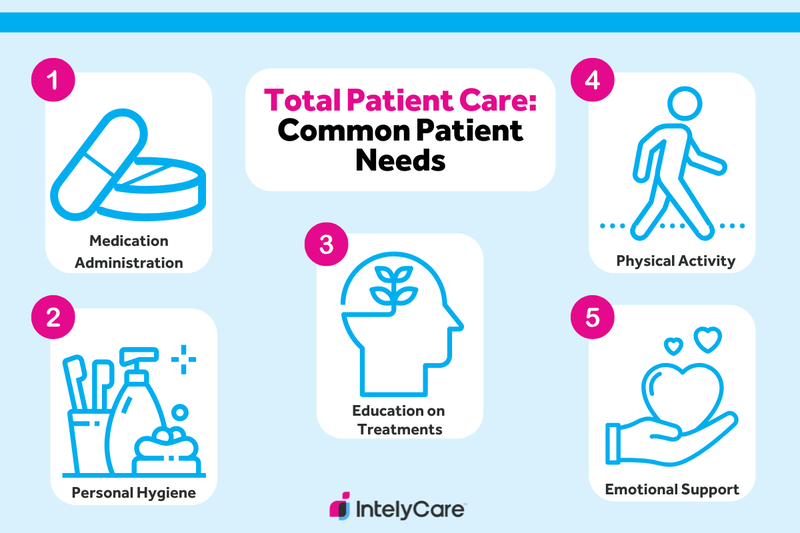
Total patient care involves a registered nurse assuming responsibility for all the care needs of a patient (or a small group of patients) for the duration of their shift. They bear the onus for all of a given patient's needs, which could include:
- Medication administration
- Personal hygiene
- Education on treatments
- Physical activity
- Emotional support
These care tasks may take place in a home or facility, to include settings where the patient-to-nurse ratio typically exceeds one-to-one. Much like a single nursing manager oversees the operational and personnel demands of a specific team, each individual nurse would manage all of the clinical duties for their patient(s).
Other nursing care models, like functional nursing care, are more task-oriented and hierarchical in structure. With the functional nursing model, patient care is team-led because senior nurses fulfill the more challenging, intensive clinical tasks while newer, less-experienced nurses perform more basic expectations. This model is efficient, but it doesn't target or ensure the close interpersonal relationships that patients desire.
The total patient care model allows nurses to maintain ownership over the care of their particular patient(s) and take accountability for the required tasks. Beyond facilitating closer relationships with patients, giving nurses more professional responsibility can improve team morale and reduce staff burnout.
What Factors Should Be Considered?
While total patient care is the traditional style of nursing in facility settings, there are benefits and drawbacks to using this approach. Hospitals can consider the following factors when deciding which style of care works best for them:
- Economic: Hospital budget, average patient income level, local cost of living
- Social factors: Race, gender, ethnicity, geographical location
- Functional factors: Patient acuity level, hospital level of care, size of facility or unit
Even after taking these characteristics into account, knowing which care framework is right for a particular patient population can be challenging. Understanding benefits and drawbacks of total patient care nursing can help you decide if it's the right staffing model for your facility.
Total Patient Care Model Advantages and Disadvantages
As with any care model, total patient care may not be appropriate for every situation or setting. However, there are some general advantages and disadvantages associated with this model:
| Advantages | |
|---|---|
| Stronger nurse-patient relationships | A strong bond is usually formed between hospital staff members and the patients they care for over the course of a long shift. When the nurse has time toget to know the patientand their unique preferences, staff and patients are more satisfied. |
| Greater continuity of care | Redundancy and missed tasks are reduced by limiting the number of nurses caring for each patient. Patients are safer, and nurses oftenappreciate more autonomyand responsibility for direct patient care. |
| Reduced treatment time | Studies show that patients in total patient care facilities havedecreased lengths of stayversus those in other staffing models. |
| Highly qualified staff | Each nurse caring for patients needs ample experience doing a wide variety of complex tasks. As there is no division of care, each nurse is expected to be able to provide all nursing treatments. Hospitals that have teams of high-quality registered nurses providing treatments have higherpatient satisfaction. |
| Disadvantages | |
|---|---|
| Higher facility costs | Total patient care requires more licensed staff than other care styles like functional nursing. Increasedhospital spendingcan limit the efficacy of this nursing model in smaller facilities like nursing homes and hospice centers. |
| Less interprofessional communication | With every nurse focusing on their own patient assignment, there’s less collaboration and teamwork among professionals. Ineffective communication and tunnel-vision approaches can lead todelayed treatment, miscommunication, medication errors, and even death. |
| Inefficiency in smaller facilities | Smaller departments like ambulatory care and hospice centers don’t need a large staff of nurses to provide safe care. These low-acuity settings have fewer complicated tasks, and often have fewer patients requiring treatment. Other models liketeam-based nursingare more helpful in these settings. |
| Increased demands on nurses | If used in inappropriate situations or settings, this model can placeincreased demandson nurses. Patient loads may become too high, or there may be certain patient needs that the nurse on duty can’t tend to. |
Discover Innovative Ways to Deliver High Quality Care
The total patient care model is one research-driven approach to better care. For other expert-vetted practice recommendations, we've got you covered with our large range of up-to-date facility guides and healthcare insights.