

Artificial intelligence (AI) is becoming increasingly embedded within many healthcare processes. This extends to finance and compliance protocols, where the use of AI for healthcare fraud detection is being explored to leverage the tool’s advanced analytical capacity for identifying and tracking revenue data patterns that may reveal fraud schemes.
With rising nationwide healthcare costs and 3-10% of those expenditures lost to fraud, addressing this issue is a critical component of cost containment. This guide examines the use of AI for fraud detection in healthcare, answering some key questions about its capabilities and impacts. With a clearer understanding of how this technological tool is used to detect fraud, you can strengthen your organizational compliance measures while improving financial oversight.
The Significance of Fraud Detection in Healthcare
Healthcare fraud jeopardizes beneficiaries’ wellbeing and financial health. That loss of 3-10% of all healthcare expenditures to fraud can translate to a potential annual loss of more than $400 billion systemwide. That decreases the funding available for essential resources and services while driving higher insurance costs.
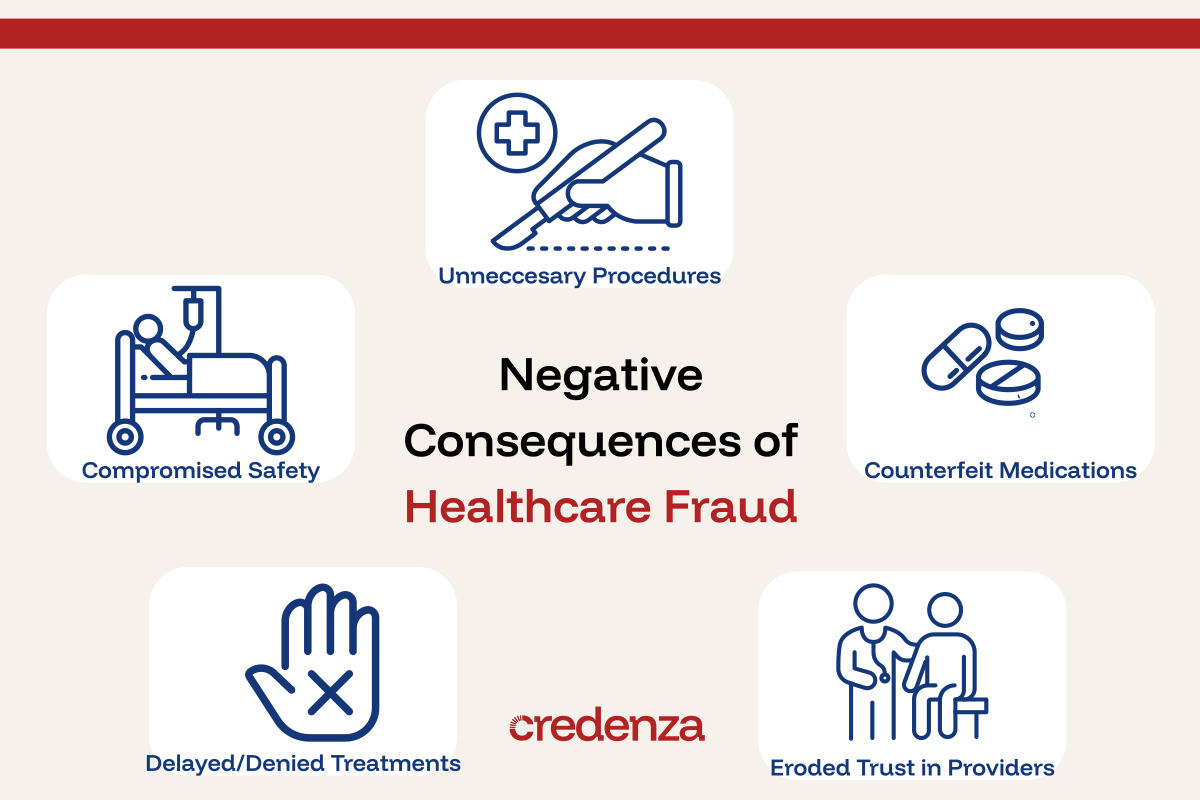
At a time when healthcare is already increasingly unaffordable for many patients, tackling unnecessary price inflation is vital. Using more sophisticated tools for fraud detection in healthcare offers a clear path to controlling those unnecessary losses while strengthening systemic integrity, limiting the additional consequences of fraud such as:
- Substandard or unnecessary therapeutic procedures.
- Compromised patient safety.
- Counterfeit medications.
- Delayed or denied treatments.
- Eroded trust in healthcare systems and providers.
Common Types of Healthcare Fraud
Fraudulent activities in healthcare can be labeled as internal (meaning, perpetrated by healthcare employees) or external (by patients or third party companies, for example). The warning signs that it’s occurring range across a variety of red flags, from inconsistent documentation to atypical treatment charges. However, some of the most common healthcare fraud schemes that artificial intelligence tools may be used to detect include the following:
| Common Healthcare Fraud Schemes | |
|---|---|
|
Medical Coding Fraud |
Knowingly using the wrong billing code to increase reimbursement is called upcoding, and is a common example of internal fraud. |
|
Kickbacks |
Kickback fraud schemes occur when providers make specific referrals to items and services in exchange for compensation. |
|
Drug Diversion |
The deflection of prescription medications to the illegal drug market can happen internally and externally. |
|
False Claims |
Upcoding is a specific type of false claim, which is an umbrella category for any billing that falls outside procedural (and ethical) standards. Other examples include charging for services never rendered and double billing. |
AI Healthcare Fraud Detection: Impacts
Healthcare fraud is evolving alongside technology. For example, cyberattacks that result in identity theft make it easier for those responsible to perpetrate false claims using stolen data. To mitigate the impacts of these breach events, more organizations are turning to AI in fraud detection. In healthcare, early identification is key to mitigating the negative impacts of a breach. Machine learning (ML) and other subsets of AI can help to quickly identify patterns that raise suspicions for scam activity.
As healthcare continues to grow increasingly digitized, artificial intelligence offers organizations a tool that keeps them in the technological arms race against fraudsters, while closing compliance gaps through rapid, large-scale data analysis.
AI for Healthcare Fraud Detection: FAQ
Now that you’ve learned what types of schemes artificial intelligence fraud detection tools may be searching for within healthcare settings (and why it matters for patient and organizational wellbeing), you may be ready for some finer details. We'll answer a few key questions regarding the specifics of how AI detects fraud in healthcare, and some important implementation considerations.
How does using AI for healthcare fraud detection work?
Artificial intelligence is useful in fraud detection because of its ability to process large volumes of data in very little time. With machine learning, it can utilize a healthcare fraud detection dataset, rapidly comparing billing information against historical revenue datasets and flagging discrepancies. Some of the most effective features of AI for identifying and preventing fraud include:
| How AI Detects Fraud in Healthcare: Methods | |
|---|---|
|
Real-Time Pattern Recognition |
Analyzing claims as they happen means anomalies are flagged before payment is fully processed, preventing losses to fraud rather than simply identifying it after the fact. |
|
Predictive Analytics |
This proactive approach identifies scenarios that risk fraudulent activity, offering a path to prevention. |
|
Natural Language Processing |
These applications are able to detect inconsistencies within unstructured text data, like the claims narrative within a medical record. This is particularly helpful for revealing sophisticated fraud schemes that rely on fabricated information. |
|
Systemic Integration |
Seamless integration into electronic health records (EHRs) allows for more comprehensive AI data analysis, streamlining and automating the fraud-flagging process. |
How does AI fraud detection technology differ from non-AI methods?
One of the primary benefits of AI over traditional fraud detection services is that it’s able to quickly adapt, improving to keep up with increasingly complex scams. It offers a proactive approach through real-time claims dataset analysis and predictive analysis vs. the reactive approach of many traditional systems, including:
- Rule-based systems which use pre-defined triggers (like out-of-character transactions) to flag suspicious activities. These risk missing more subtle crimes.
- Manual monitoring, or when employees monitor accounts and datasets, which is labor intensive and sometimes slow.
- Transaction monitoring, a method that usually involves software, designed to flag anomalies like double billing. It relies on a set comparative baseline and may miss new, evolved fraud schemes.
Are there any regulations that govern AI healthcare fraud detection?
There are currently no comprehensive federal laws or guidelines for how AI (within healthcare) should be regulated. In its absence, states are establishing their own rules around the use of AI in healthcare. For example, Texas prohibits the use of automated systems to make adverse determinations on behalf of utilization review agents, while Maryland has enacted guardrails around the use of AI within the review process.
So, while there’s no direct legislation that directly impacts the use of AI for fraud detection, its implementation may look different from state to state based on the unique rules regarding automated decision-making capacity within healthcare claims and billing systems.
Is AI widely used across healthcare settings for fraud detection?
Although AI is still considered an emerging technology, it’s quickly becoming a widespread tool for healthcare fraud detection across systems. It’s in use by the Louisiana Department of Health for reviewing Medicaid recipient eligibility. At the national level, the Centers for Medicare and Medicaid Services (CMS) has introduced the Wasteful and Inappropriate Service Reduction (WISeR) model, which will leverage AI to promote cost reduction and service integrity.
Private EHR companies like Epic have also integrated AI into billing processes, using both generative and predictive artificial intelligence systems to assist with appeals. Across private and public healthcare industry sectors, the data-processing tool is quickly becoming a mainstay within both clinical and administrative functions.
What are some pros and cons of AI healthcare fraud detection?
The integration of innovation (technological or otherwise) has its advantages and disadvantages. To safely adopt AI for healthcare fraud detection, reviews of both the benefits and liabilities are necessary.
| Pros | Cons |
|---|---|
|
Scalability and adaptability are the primary assets of an artificial intelligence system. They allow the tools to monitor and interpret vast quantities of data while quickly adapting to new needs (or threats). |
False positives jeopardize the reputation of provider and systemic brand images, while risking delays to patient care as critical resources are suspended, pending investigations. |
|
Real-time detection means that fraud can be identified before losses come to fruition, allowing for proactive prevention rather than retroactive punishment. |
Lack of transparency around decision-making has the capacity to further erode public trust in healthcare systems. This could widen the already growing mistrust of the healthcare sector. |
|
Long-term cost savings by replacing antiquated protections that can’t keep up with innovative scams. |
Costly implementation is another consideration. AI technology is still new and may be cost prohibitive for many organizations. |
What precautions should accompany the use of AI for fraud detection in healthcare?
As with the use of AI within clinical spaces, its implementation within administrative departments still requires human oversight to optimize its effectiveness and minimize risks. The technology can flag concerns faster and more efficiently than human beings, but (currently) lacks the decision-making capacity to decipher the true positives from the false.
When anomalies or inconsistencies are identified by AI in fraud detection, in healthcare settings, it’s still in the best interest of both the institutions — and the patients they serve — to allow human beings to determine the final response to suspicious reports.
Want Other Ways to Safeguard Your Healthcare Reputation?
Using AI for healthcare fraud detection is one method of safeguarding your billing processes and institutional integrity. Use our wide range of expert-backed healthcare insights and facility guides for other strategies to protect your reputation alongside patient (and organizational) wellbeing.