

Healthcare credentialing and privileging decisions are often based on data sourced from both the FPPE and the OPPE. What is FPPE vs. OPPE? The Focused Professional Practice Evaluation (FPPE) and the Ongoing Professional Practice Evaluation (OPPE) are interrelated practitioner competency assessments. They’re required by the Joint Commission for ensuring that physicians and advanced practice providers (APPs) deliver safe, high-quality patient care.
It’s important to understand how each type of PPE is conducted and why they matter to credentialing and privileging. In this guide, we’ll explore each of those subjects through a concise overview with answers to key FPPE- and OPPE-related questions. With a better understanding of these mandatory assessment processes, you’ll be well-positioned to maintain regulatory compliance and promote a culture of continuous quality improvement.
Provider Profiles as Informed by FPPE and OPPE
The OPPE and FPPE both contribute to provider profiling, a structured process of collecting and analyzing practitioner-specific performance data to evaluate clinical competence and quality. Unlike the primary source verification that’s required for initial credentialing processes, these evaluations largely inform the privileging (what a provider can deliver to patients), reappointment, and professional development decisions that follow. They’re based on internal data, including case reviews, patient outcomes, and peer feedback.
The OPPE is ongoing, reviewed at least every 12-months, and is meant to identify trends related to care quality and safety. The FPPE is a focused, time-limited evaluation that can be applied proactively or reactively. A proactive FPPE is assigned to all practitioners undergoing initial credentialing and privileging measures. A reactive FPPE (meaning, an evaluation that’s triggered by a concern) is used to further assess a specific event or flagged practice data to evaluate the risk to patient safety.
OPPE vs. FPPE: Credentialing Significance
Credentialing isn’t a one-time event. In fact, it’s a cycle that’s partially informed by the PPEs. Medical staff (such as physicians and nurse practitioners) must undergo reappointment every three years, initiating a sequence of re-verification and performance evaluation measures to support ongoing compliance with regulatory and accreditation standards. Both PPEs (ongoing and focused) provide structured, unbiased, and data-driven insights that support an evidence-based demonstration of provider competency in regard to:
- Clinical knowledge.
- Professionalism.
- Multidisciplinary communication.
- Procedural competency.
- Patient outcomes and performance metrics.
While both assessments inform reappointment decisions, OPPE medical staff assessments ensure that provider profiles remain dynamic through continuously updated quality and performance data. In contrast, FPPE medical staff assessments are time-limited and provide a focused evaluation of a provider’s capacity to perform specific privileges. It’s required before granting initial or new privileges and may also be initiated for cause, when a performance or quality concern is identified.
A cause-driven FPPE may lead to additional review and corrective actions. Per Joint Commission guidelines, the FPPE itself is nonpunitive. However, its findings do have the potential to impact future privileging decisions.
FPPE vs. OPPE: FAQ
If one were to approach the FPPE vs. OPPE as a Venn diagram, their distinctions would largely relate to scope and frequency. Their overarching purpose is where the overlap occurs. Both assessments are meant to support (and strengthen):
- Care quality and safety.
- Regulatory compliance.
- Patient and clinical outcomes.
- A culture of continuous improvement.
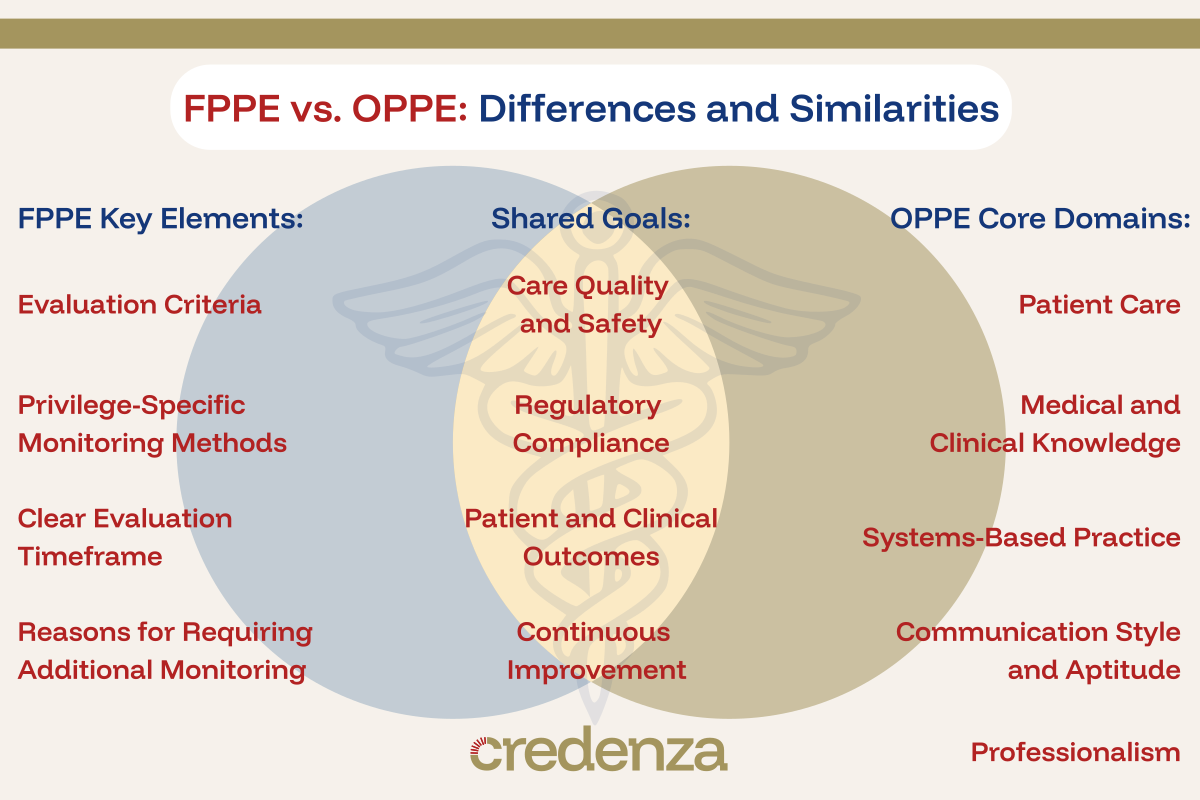
To further address both the distinctions and similarities of these two performance evaluations, we’ll answer some key questions about their application and significance below.
Are there specific testing requirements within the FPPE and OPPE?
Neither evaluation is defined by a single test, or systemwide OPPE and FPPE forms. Instead, the Joint Commission gives organizations quite a bit of flexibility to create their own evaluation-based policy and framework. This means that the evaluation criteria, methods, and timeframes are often organizationally specific.
While processes may vary among institutions, all evaluations (within a health system) must be data-driven, consistent, unbiased, and fairly and uniformly applied to every provider of every specialty. To ensure these criteria are met, many facilities do use a standardized FPPE and OPPE template. These are often decided by patient population-specific metrics, the provider specialty, or to better address the causative factors that triggered an FPPE. Examples of core domains measured within a standard OPPE include:
- Patient care.
- Medical and clinical knowledge.
- Systems-based practice.
- Practice-based learning and improvement.
- Communication style and aptitude.
- Professionalism.
For FPPEs, the Joint Commission requires institutions to define several key elements within their process, including:
- The evaluation criteria.
- Privilege-specific monitoring methods.
- A clear evaluation timeframe.
- Reasons for requiring additional or external monitoring.
What reasons might drive an FPPE for cause?
A triggered FPPE review may be initiated by the provider’s department for a wide range of causes. However, the concern must be evidence-supported and relate back to care quality or safety. Example causes that may trigger an FPPE include:
- A patient-related incident or significant event attributed to the practitioner (directly or indirectly).
- Failure to follow procedural or clinical standards.
- A substantial number of complaints from staff members, patients, and/or patient families.
- Specific indicators of clinical incompetencies.
- Inappropriate or disruptive behaviors that breach the medical code of professionalism.
- Any circumstances (including physical or mental concerns) that incur questions about a provider’s ability to provide competent, safe patient care.
Which organizations are required to administer the FPPE vs. OPPE?
Since 2008, any Joint Commission-accredited hospital or healthcare facility that grants provider privileges must administer provider performance evaluations in accordance with the standards, MS.08.01.01 and MS.08.01.03.
When is the FPPE vs. OPPE administered?
Although the Joint Commission doesn’t have a specific mandated frequency for OPPEs, they must be conducted on a routine, ongoing basis at defined intervals. Their data must be reviewed more than every 12 months for regulatory compliance (prompting many facilities to complete reviews every 4-6 months). The focused PPE is time-limited, but occurs in response to specific triggers, including:
- Initialing privileging for newly credentialed providers.
- Requests for new or expanded privileges by established providers.
- Evidence-based cause (such as a flagged number of surgical adverse outcomes).
Who regulates the OPPE and FPPE? Joint Commission vs. federal authorities?
The primary accreditation authority that explicitly requires the use of focused and ongoing evaluations is the Joint Commission. OPPE requirements (and those of the FPPE) do often align with the directives of other accreditation bodies. For example, the Centers for Medicare and Medicaid Services (CMS) requires data-driven performance monitoring and quality improvement measures through its Quality Assessment and Performance Improvement (QAPI) program.
This means that facilities may leverage their Joint Commission-compliant FPPE and OPPE policies (or frameworks) to also achieve compliance with CMS requirements.
What is OPPE in healthcare’s value as a continuous evaluation?
Its proactive approach is one of the main benefits of the OPPE, meaning it can provide early identification of concerning trends before they escalate into significant safety or quality issues. By continuously analyzing performance and quality metrics at regular intervals, OPPE supports intervention while mitigation is still possible.
To maximize its values, organizations should ensure that their OPPE frameworks incorporate targeted metrics that align with organizational priorities and patient population-specific needs. This helps generate meaningful insights that can guide follow-up actions for measurable clinical and performance outcome improvements.
Why are FPPE and OPPE important to patient safety?
These performance evaluations support ongoing and focused efforts to monitor providers and authenticate their capacity for high-quality patient care. Some of the ways that OPPE supports improved patient safety and wellbeing include:
- Early risk identification by tracking performance trends.
- A clear pathway to remediation by flagging specific data outliers.
- Better accountability through continuous monitoring and routine data reviews.
- Improved compliance among multisystem regulations (such as CMS Conditions of Participation).
FPPE also benefits patient safety and wellbeing through:
- Validating new providers’ ability to safely deliver care beyond initial primary source verification measures.
- A process for escalating provider-related patient safety and care quality risk factors.
- Recommendations for remediation and correcting identified clinical privilege issues.
- Stronger regulatory and best practice compliance by holding providers accountable for maintaining safety and quality-related standards.
Align Your Quality Initiatives With Patient Safety Efforts
Whether reviewing insights from an FPPE vs. OPPE, these performance measures are just the beginning. Continue driving better patient outcomes with the help of our facility guides and management insights, designed by clinical and legal experts to support the highest quality patient care.