

As healthcare organizations hire more advanced practice providers (APPs) such as physician assistants (PAs) to meet patient demand, it’s increasingly important to ensure accurate and compliant billing. Physician assistants engage in nearly 600 million patient interactions every year across the U.S., making proper PA reimbursement essential to maintaining a healthy revenue cycle.
In this guide, we’ll outline key PA billing concepts and answer some common questions to ensure clarification around complex details. With a well-informed understanding of these important processes, you can confidently optimize both physician assistant productivity and reimbursement, supporting efficient systemic operations while strengthening overall clinical performance.
PAs as Advanced Practice Providers
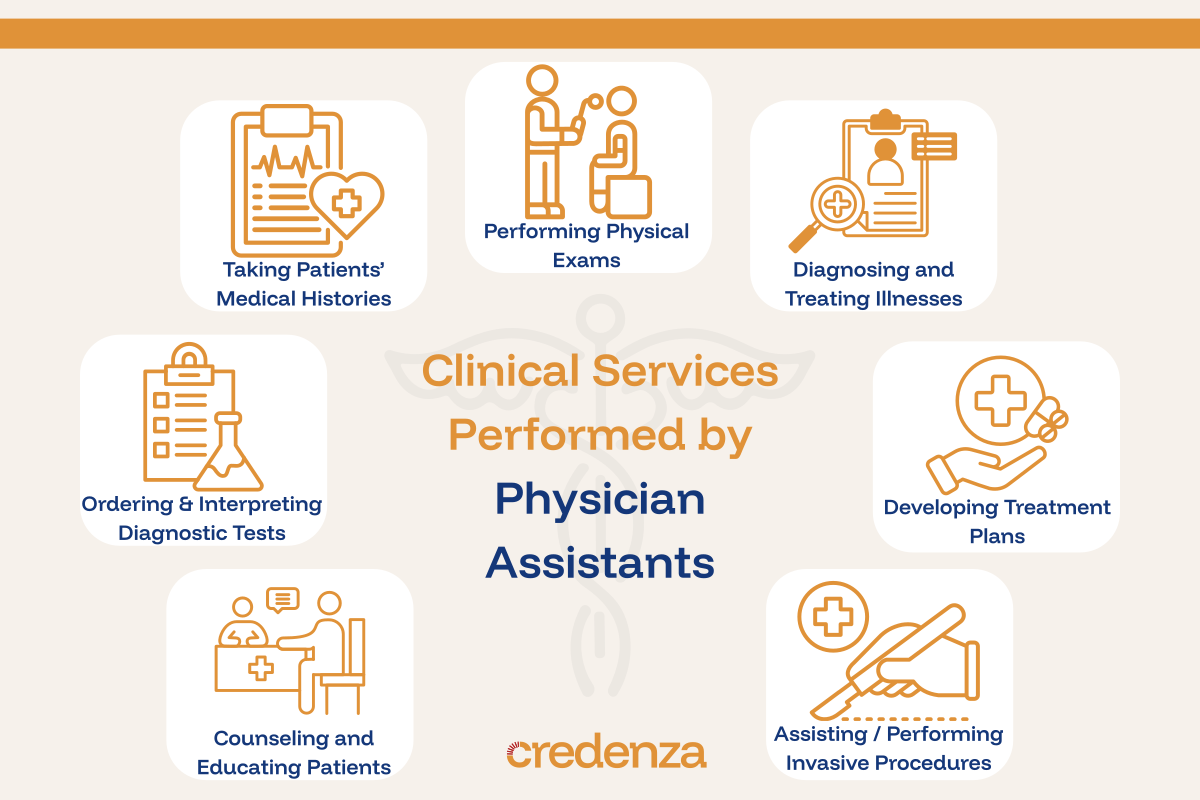
Physician assistants are licensed medical professionals that practice across a variety of healthcare settings. Whether working in a clinic or urgent care, their scope of practice is defined by state laws, physician collaborative agreements, and employer policies. Despite the potential for state-to-state (or facility-specific) variations in practice autonomy, PAs generally support a broad range of clinical services, including:
- Taking patients’ medical histories.
- Performing physical exams.
- Diagnosing and treating illnesses.
- Ordering and interpreting diagnostic tests.
- Developing treatment plans.
- Counseling and educating patients.
- Assisting or performing invasive procedures.
State-based regulations directly impact how a PA fulfills these many responsibilities. Yet their impacts to billing are indirect and based primarily around how they affect:
- The type of service a PA can provide.
- The setting where the PA practices.
- The degree of physician involvement.
Billing for a Physician Assistant: FAQ
State-based PA practice laws may exert some influence over reimbursement procedures, but PA billing (under supervising physicians or as near-independent providers) is largely governed by health plan payer rules. These rules, such as those set by the Centers for Medicare and Medicaid Services (CMS), establish the reimbursement standards for billing. Physician assistant requirements among health plans are typically separate from those of MD- or DO-licensed doctors, making the revenue process slightly different for those practitioners.
Below, we’ll answer some key questions about these billing guidelines for PAs, highlighting some important differences among federal vs. commercial payer policies, and identify common billing mistakes that may indicate risky or noncompliant physician assistant billing practices.
Can physician assistants bill independently?
The short answer is that it depends on how independently is defined. Under the CMS guidelines, PAs can bill directly under their own credentials for covered services. Yet, because Medicare doesn’t define PAs as independent practitioners, these directly billed services are reimbursed for only 85% of the payment granted to physicians for the same services.
Some third-party payers (including CareFirst) have different policies that don’t allow PAs to bill directly for their services at all. In these cases, the PA often bills indirectly, using their overseeing physician’s credentials to request reimbursement for services rendered.
PA direct billing always requires:
- Valid credentialing with each insurance payer.
- Proper NPI enrollment and maintenance.
- Adherence to individual payer plan policy guidelines.
- Complete and accurate medical records documentation.
Do PAs use their own NPI when billing patients?
National Provider Identifiers (NPIs) are unique 10-digit identification numbers required by all providers who engage in electronic healthcare transactions, including medical billing. When a physician assistant bills directly (to CMS, for example), those services are submitted under the PA’s own NPI.
Who manages APP billing? Physician assistants themselves, or admin teams?
Across almost all healthcare settings, the correct answer is both. PAs (like other providers) are responsible for ensuring their documentation supports the level of billing. Administrative — or revenue — teams typically use that documentation to assign the correct ICD and CPT codes, often submitting the final claim on the provider’s behalf.
In small practices that don’t have access to billing support, PAs may code and submit their own claims. No matter who sends the request, though, it’s always the responsibility of the clinician to ensure that the billing request is accurate, compliant, and well supported.
Is the physician assistant reimbursement rate the same as that of a physician?
Many private insurers model their policies after the CMS guidelines, reimbursing PAs at 85% of the physician fee schedule amount when billing under their own NPI. However, commercial payer plans can vary. Some may reimburse PA services at rates comparable to those of physicians. Reimbursement is ultimately subject to the specific insurer contract.
What are the key CMS physician assistant billing guidelines?
Billing Medicare is a highly regulated, often-complex process for all clinicians. The first provision of proper Medicare billing includes applying for and maintaining an NPI. With that 10-digit identifier, PAs (among other providers) can submit claims for their services directly.
Medicare then pays 80% of the allowed reimbursement amount, which for PAs (and other APPs) is 85% of what a physician would be paid. However, there are provisions — like incident-to billing for nonphysician providers — that allows PAs to bill for higher reimbursement rates.
Does incident-to billing allow PAs to bill at 100%?
Incident-to is a Medicare billing mechanism that allows APPs (including PAs) to be reimbursed at 100% of the physician fee schedule rate as long as certain clinical and documentation criteria are met. These include:
- Setting: Incident-to billing is limited to outpatient healthcare settings and doesn’t apply to hospital or facility-based care.
- Billing Provider: The service must be billed under the supervising physician’s NPI.
- Service Type: Patients must be established, with the initial exam and treatment plan completed by the physician. Any changes or new problems require re-evaluation by the MD (or DO) specifically.
- Supervision: The physician doesn’t have to be in the room for every follow-up, but they must be on site and immediately available during every patient visit. Ongoing participation in care is also required.
When is the substantive portion used for billing physician assistants?
The substantive portion rule applies during split (or shared) visits within facility settings when patients are seen by both a physician and a PA. In these cases, the CMS billing provider depends on who spent more than half the total time with the patient (or handled the majority of medical decision making), therefore performing the substantive portion of the service delivery.
If the PA is responsible for the substantive portion of the shared patient care, then they would bill for services under their own NPI. If the physician performs the substantive portion of care, then it would be billed under the physician’s NPI.
How does time-based billing compare to complexity-based billing for PAs?
Complexity-based billing — more commonly known as medical decision-making (MDM) billing — is used by PAs and other providers to determine the level of service based on the complexity of a patient’s condition (and the related care management decisions). Time-based billing, on the other hand, uses the total time the provider spent (on the date of the encounter) to determine the level of service.
Both methods are valid billing options under CMS guidelines and many third-party payers, but providers must choose one method per visit. Each approach requires comprehensive documentation. For MDM-based billing, a PA must clearly document the complexity of the patient case and management options. When billing based on time, the PA must thoroughly document the total time spent, and the associated activities performed, on behalf of the patient.
Are there any common mistakes or red flags associated with PA billing?
When it comes to billing, physician assistants’ frequent mistakes are shared by all provider types, and can lead to claims denials, delays, and even compliance risk. These common errors include:
- Incomplete billing information, such as missing demographics or NPI details.
- Insufficient documentation to support the care being billed.
- Coding errors, including inaccurate authorization numbers or incorrect CPT codes.
- Duplicate billing for the same service or encounter type.
- Out-of-network or non-covered service claims, or claims submitted without the required prior authorization.
Issues that are specific to billing for a physician assistant often relate to compliance with health plan payer rules (or state-specific practice laws). These include:
- Improper incident-to billing, including when an established patient reveals a new problem that the PA addresses (instead of referring the issue to the physician).
- Using the wrong NPI number for billing, especially in instances of split or shared care.
- Billing for services outside the PA scope, which results in immediate rejection no matter the clinical relevance or quality of documentation.
Want to Ensure Your Regulatory Compliance Is Airtight?
When it comes to regulatory updates and complex billing, physician assistants aren’t alone in feeling overwhelmed. That’s why we provide practical guidance on the latest compliance updates and insights, helping you to stay current, reduce risk, and streamline compliance with confidence.