

Insurance enrollment often prompts many new providers to ask, What is CAQH credentialing in healthcare? That’s because as a nonprofit organization, the CAQH (or, Council for Affordable Quality Healthcare) has become an industry mainstay, known for its efforts in simplifying the administrative and business aspects of healthcare.
The system works by offering one, centralized database (known as CAQH ProView) for provider qualification and credential verification. This means that practitioners need only enter their information once to the CAQH-maintained portal for use across multiple authorized health plans.
To further clarify how to use CAQH for credentialing, we’ll examine some key components of both their requirements and intent, and answer common questions about the database service. This will put you in a better position to streamline your current hiring and onboarding processes while strengthening the quality of your patient care and regulatory compliance.
The Council for Affordable Quality Healthcare: Background
CAQH was founded in 2000 as a nonprofit alliance of health plans and trade associations, working to improve the efficiency and effectiveness of healthcare’s business components. Since its launch, the council now provides information coverage for over 200 million members, offering a common, trusted reference point for their medical licensure details, education history, and board certifications.
Although it supports credentialing processes, it doesn’t actually approve credentials. Instead, it provides a single point of entry, streamlining access to primary source authentication information. As a platform, it supports reducing the administrative overhead for:
- Initial credentialing, or the first time that a provider seeks enrollment within a health plan network.
- Recredentialing, which is the mandatory in-network renewal that occurs roughly every 2-3 years.
- Provider enrollment, which happens when a provider is linked to a group or facility’s contracts
- Demographic verification, or a double check that directory details (like an office address) are correct.
CAQH: Credentialing Checklists
Key CAQH checklists reveal both the information requirements and the necessary documentation to support a completed profile. Providers need to be ready to supply all the following information:
1. Personal Identifiers
The required personal information includes full name, date of birth, Social Security Number (required by some health plan providers), gender, citizenship, language(s) spoken, geographic information, and (in some cases) a professional headshot.
2. Professional Identifiers
These include the practitioner’s National Provider Identifier (NPI), tax identification numbers and identification, and (where applicable) Medicaid identification.
3. Education and Training Details
This information needs to reflect the extent of a provider’s education and training, including their medical (or graduate) school details, degree type, and graduation date. It also includes residency or fellowship training information (like starting and ending dates) in addition to specialization. International candidates will need proof of completing the Educational Commission for Foreign Medical Graduates (ECFMG) certification.
4. Licensure and Certification
All active, state-based, professional licensure information such as the state name, license number, issue and expiration dates, needs to accompany certification details like DEA registration information, state-specific controlled substance permits, and board certification details for any medical specialty.
5. Work History
A detailed, chronological statement regarding past work history (covering the previous five years) must detail each position held, including start and end dates. Gaps of more than 90 days aren’t permitted on the form without qualification.
6. Professional References
It's standard practice to include two to three professional references from peers or supervisors who can support the stated work history. Contact details for these references, such as name, title, and their phone number (or email), must be included.
7. Practice Details and Hospital Privileges
The name, location, and contact details (a phone number, for example) for each current practice location needs to be listed in addition to whether the provider is accepting new patients at that location. If the practitioner is part of a group practice, then the group name and tax ID need to be included.
8. Malpractice Insurance (and History)
Proof of current malpractice insurance coverage needs to be demonstrated. Be prepared to supply the carrier name, policy number, coverage amount, and expiration date in addition to a malpractice policy face sheet. Details regarding any past malpractice claims or incidents must also be acknowledged.
9. Background Disclosure
This often involves a yes/no questionnaire that will check for any previous disciplinary actions or license citations, criminal convictions, Medicare or Medicaid sanctions, or past credentialing denials, among other possible liabilities.
10. CAQH Attestation and Consent
This final step is the legal acknowledgement that all of the provided information is correct. Once a provider attests to their profile’s accuracy, they must give consent for the information to be shared and accessible across participating health plan payers. These final steps make the provider profile available for credentialing and directory purposes.
To verify the information listed above and support efficient onboarding measures, CAQH credentialing applications will require digital copies (PDF or images) of the following documents:
- State license(s) for each current state of practice
- If applicable: DEA certification or Controlled Dangerous Substance certification
- Any board certifications (or proof of eligibility)
- A malpractice policy facesheet that’s current.
- Medical or graduate school diplomas.
- Residency (or fellowship) completion certificate(s) or ECFMG certification where applicable.
- An up-to-date curriculum vitae (CV) or resume.
- A W9 tax form that’s signed and dated.
- Hospital privilege letter.
- As required by some coverage providers: a copy of a photo ID (like a driver’s license).
- A professional headshot is recommended to complete the CAQH profile.
Credentialing With CAQH Support: FAQ
Credentialing through CAQH is a multistep, ongoing process that requires provider participation. As a data repository, it can significantly reduce administrative overhead costs and improve the efficiency of enrollment and verification processes.
To help further clarify how the nonprofit supports better credentialing practices, we’ll answer some common questions that go beyond, What is CAQH and credentialing’s connection?
What does CAQH stand for in credentialing? Does it verify a specific credential type?
The acronym CAQH stands for the Council for Affordable Quality Healthcare. As the name implies, it’s meant to reduce healthcare costs and works to achieve this by offering a central registry for providers to self-report qualification information (notably with CAQH ProView).
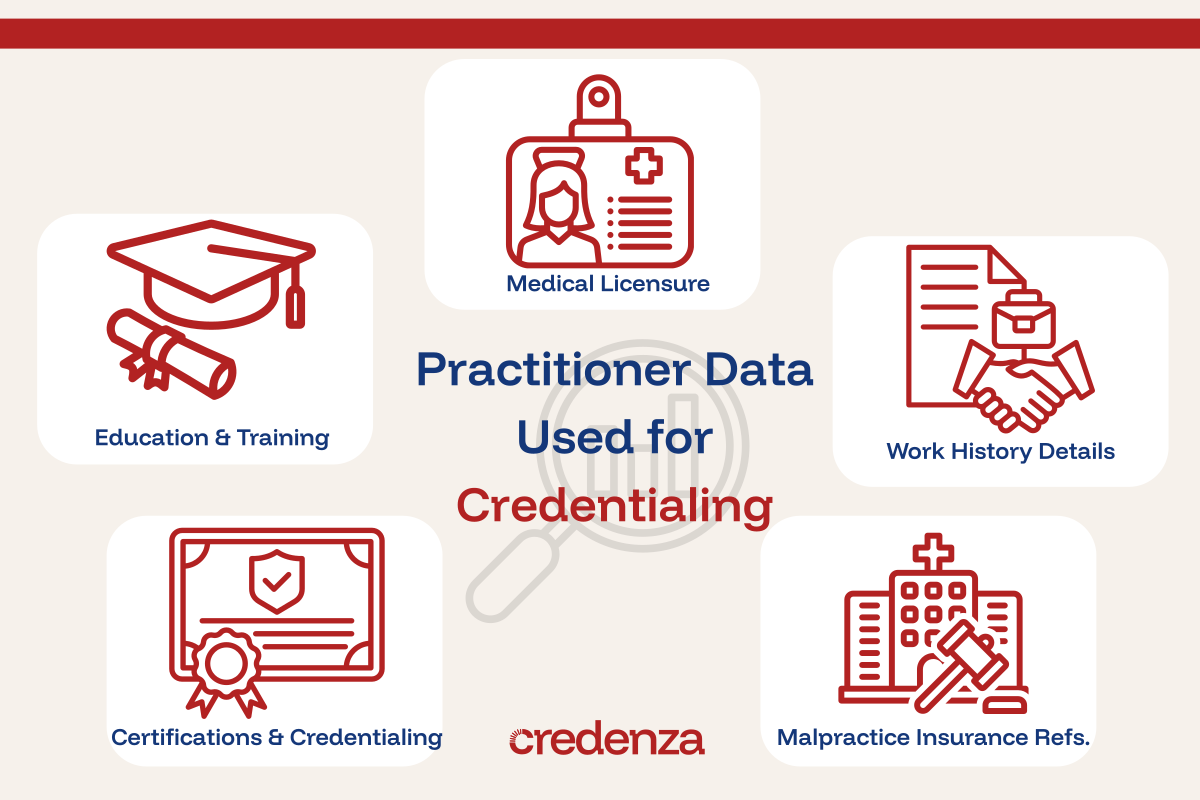
Because of this, it doesn’t provide a single credentialing service. Rather, it provides streamlined access to practitioner data to support generalized credentialing needs, including:
- Medical licensure information.
- Education and training background.
- Work history details.
- Certifications and credentialing.
- Malpractice insurance references.
Is there a standard CAQH credentialing process?
No. This is because CAQH doesn’t perform a credentialing process. Instead, it facilitates easier access to information profiles that inform health plan organizations’ enrollment decisions. Participation requires the creation of a profile, completed by submitting all the necessary information. Incomplete CAQH profiles (or statuses), are a leading cause of revenue delays within private practice.
How long does CAQH credentialing take?
Using the CAQH ProView Portal is meant to help reduce credentialing timeframes. However, it can take more than a month for a CAQH profile application to gain approval. The average wait time for a new provider is between 90 and 120 days. Once it’s approved, that information remains available for any enrollment or credentialing purposes as long as the profile stays current.
To maintain the profile, each provider is required to (within 120 days) complete the CAQH attestation: Login to your CAQH profile, review or update information to ensure it’s still up-to-date, and submit for reapproval. Approval for re-attested information typically takes only a few days.
How much does CAQH credentialing cost?
For individual providers, access to CAQH Proview is free. That means that they can create and maintain a profile at no cost, contributing to a centralized database that facilitates better intersystem cooperation and streamlined credentialing.
For organizations, CAQH itself doesn’t charge per-provider credentialing fees. Instead, costs are typically associated with how credentialing is managed. In-house management requires paying staff to support credentialing and compliance. Alternatively, some organizations choose to pay a credentialing vendor, which may charge on a per-provider basis, with fees ranging from as little as $50 to over $1,000 (depending on the level of service).
Can CAQH credentials expire?
CAQH profiles (which verify a provider’s self-reported credentials) don’t technically expire, but they can lapse if re-attestation isn’t completed within the 120-day requirement. Missing this deadline will change the profile status to Not Current.
This can impede reimbursements and revenue cycles for the provider and their associated practice. So, it’s very important that all those enrolled use their CAQH provider login to access the portal and update their information (or simply review their profiles if no changes are needed) before the deadline of each attestation cycle.
Are there any common CAQH credentialing errors to watch for?
These three mistakes can jeopardize a provider’s CAQH credentials profile:
- Attestation Expiration, or missing the 120-day information review deadline. Automated reminders or attestation alerts are a great tool for avoiding profile lapses.
- Incomplete (or Inaccurate) Profiles, which can lead to claims denials or a rejected health plan enrollment application. Using CAQH documentation checklists can help ensure that all required information is both accurate and accounted for.
- Requirement Shifts and Changes, these make compliance an ongoing task. Automated credentialing services, or keeping up with the latest healthcare news, can limit the risk of unintentional noncompliance.
What’s the benefit of using CAQH as a credentialing support system?
CAQH is now a requirement for many health plan payers. Beyond its recognition as an industry-leading provider database, it supports:
- Streamlined provider verification processes.
- Time savings for providers by simplifying their paperwork requirements.
- Reduced administrative overhead costs.
- More accurate information leading to less risk for revenue disruptions.
- Enhanced compliance through a standardized provider information database and verification standards.
Protect Your Systemic Integrity With Informed Hiring
CAQH credentialing services have shone to help streamline provider onboarding processes. Continue making the most of combined hiring and verification services through our industry-leading nursing job board, designed to help fill your vacancies with vetted, qualified professionals fast.