


Increasingly competitive healthcare labor markets coupled with nursing shortages are driving the urgency of a good candidate journey — meaning that landing quality hires relies on making them feel valued before they've even accepted the job offer. In a field where quality of care frequently depends on the individuals supplying it, healthcare hiring is an indirect, yet key aspect of optimizing patient outcomes and protecting your facility's bottom line.
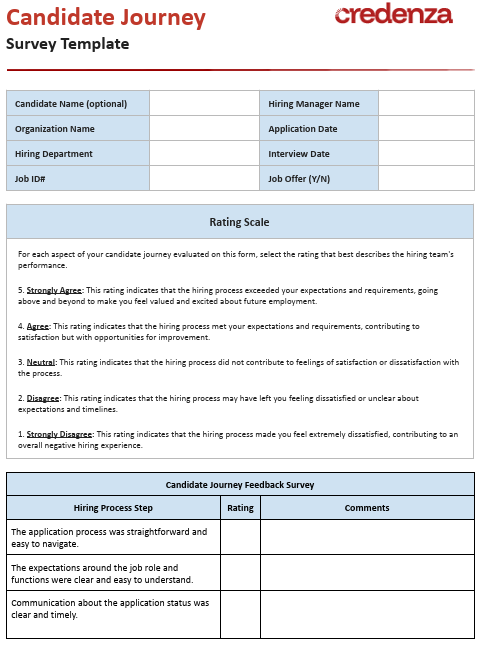
If you're ready to address your current hiring strategies with the candidate's experience in mind, we've got you covered. We'll provide a brief explanation of the topic and give you examples of successful and unsuccessful management of key candidate journey touchpoints. We'll also provide five best practices that include a commitment to constant improvement. To help with that last item, you can use our free, customizable candidate experience survey template, linked below.
What Is the Candidate Journey in Healthcare Hiring?
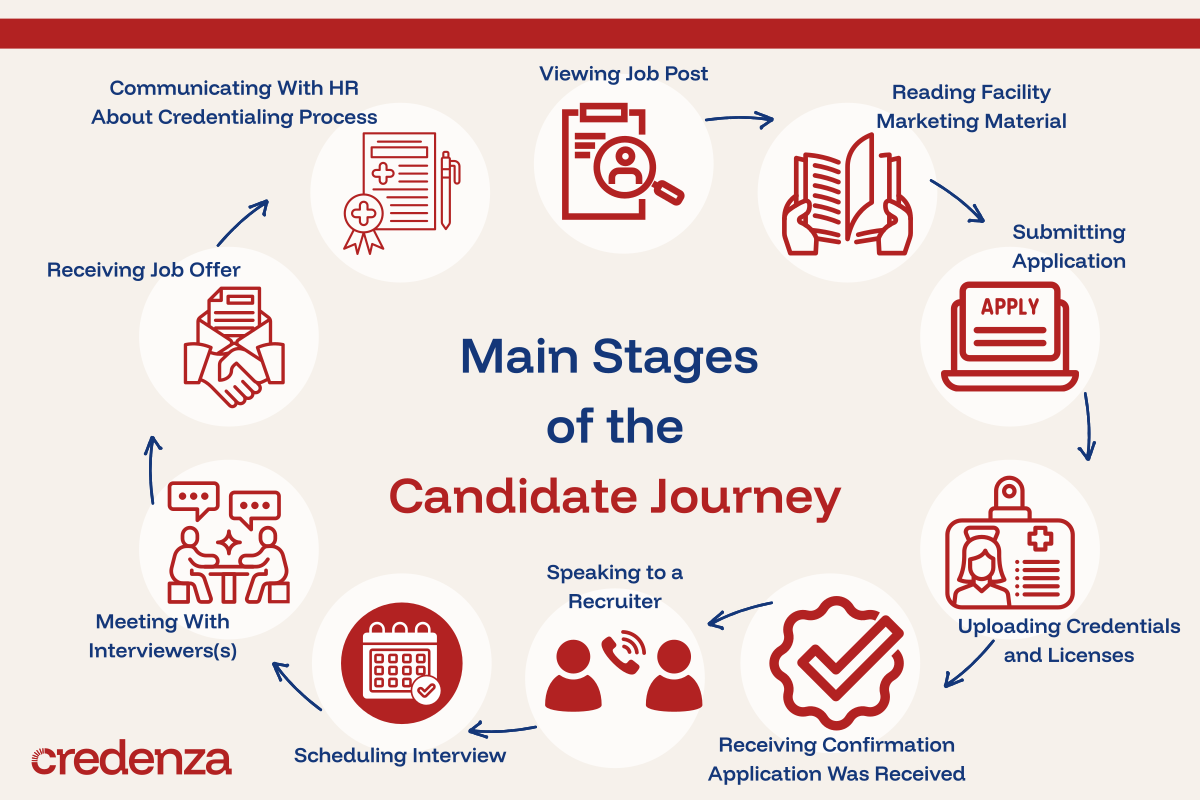
This is the path that a candidate takes with your healthcare organization, starting with awareness of the job opening and potentially culminating with day one in the practice setting. It consists of a sequence of candidate journey touchpoints that shape their understanding of the hiring organization. These communications and interactions impact their motivation for the process, for better or worse, and may include:
- Viewing the job post.
- Interacting with facility marketing material, such as a hospital website.
- Engaging with the application submission process.
- Uploading requested credentials and licenses.
- Receiving communication that confirms an application was received.
- Speaking to a recruiter.
- Scheduling an interview.
- Meeting an interviewer (or multiple interviewers).
- Receiving a job offer.
- Communicating with HR related to the credentialing process.
Why Is the Candidate Experience Important in Healthcare Hiring?
The significance of a good experience for healthcare candidates can't be overstated. More than half a million nurses intend to leave the workforce within the coming years, and nursing program enrollment rates remain comparatively low. With vacant RN positions costing organizations roughly between $20,000-$50,000 (in starting costs alone), ongoing shortages and hiring delays not only risk the quality of clinical care, but also weaken institutional viability.
Committing to fostering a hiring experience that entices the best nursing candidates can help you avoid some of these troubling trends. Research has shown that the job search process is considered one of the more stressful life experiences. The majority of candidates who have a bad experience will not only sever their connection to the company, but also dissuade others by sharing their negative impression. In the age of social media and review-driven choices, one bad experience could have serious consequences for your talent pipeline.
On the flip side, investing in a positive journey and experience for candidates has helped some companies improve their hiring outcomes by 70%. Given the cost of vacant positions and the risk associated with bad hires, the imperative of a good experience for healthcare candidates is clear.
Examples of Good and Bad Healthcare Hiring Journeys
To help clarify what we mean by good and bad hiring journeys, we've assembled a collection of examples. First, consider the following examples of successfully managed touchpoints that have positive effects on job candidates.
- The application featured a clear job description that clarified the expectations around duty functions and role.
- A callback occurred within 48 hours of applying, making the candidate feel valuable.
- Despite not landing the job, the candidate was thanked for their time, signaling their efforts weren’t taken for granted.
In contrast, consider the following candidate journey examples that lead to negative effects:
- Duplicative forms made the application process unnecessarily lengthy and cumbersome.
- The callback for an interview occurred just a few hours before the scheduled meeting time, making the candidate feel rushed and unprepared.
- Candidate ghosting left the potential hire without any answers for the sudden cease in communication or interest.
5 Tips for Improving the Healthcare Candidate's Journey
Now that you know why a positive experience matters in healthcare hiring — and what it might look like — let's consider some best practices for ensuring a good impression of your organization.
1. Prioritize the Human Element
Healthcare jobs are often fast-paced and stressful. By treating candidates with respect and extra care, you're signaling that your organization is more likely to later protect them from burnout and the burden of mounting tasks. This is huge in an industry where many nurses report feeling unsupported in jobs that lack this important human aspect.
Recommendations:
- Personalize your outreach with the candidate's name, title, and qualifications wherever possible to reflect that they're more than simply another hiring statistic.
- Approach interviews as conversations rather than interrogations and try to begin and end them with a question that allows the candidate to reflect on their best attributes.
- Consider implementing full cycle recruiting, which puts a consistent recruiter (or recruiting team) in contact with the candidate, fostering personal connections.
2. Treat Communication as a Best Practice
Bad, untimely communication is often at the heart of many negative hiring experiences. Delayed responses and lack of updates can even drive candidate ghosting, where potential hires walk away from the process with no notice and no communication. Dedicating your efforts to clear, effective communication dissuades candidates from feeling disrespected or losing interest.
Recommendations:
- Use expert-vetted job descriptions that clarify the expectations around the role and duties so that candidates don't feel surprised (or even lied to) about job requirements.
- Mimic the closed-loop communication that ensures better outcomes in the clinical environment and apply it within the recruitment and selection process.
3. Ensure Timeliness of the Process
A prolonged time-to-hire can drive candidate drop-off and lead to a smaller pool of quality candidates and a reputation for negative hiring experiences. By reducing your time-to-hire and streamlining the hiring experience, candidates develop trust in the processes of your organization, fostering an engaged, productive working relationship.
Recommendations:
- Automate steps in the early stages of the hiring process to streamline the initial steps, ensuring that automated communication is labelled for transparency alongside the reasons behind its use (for example, add a note that automated messages at this stage of hiring helps protect the candidate's time).
- Start licensing and credentialing verification early to avoid stalling the process on those crucial validation steps.
4. Maintain Transparency and Authenticity
Authenticity is a key element of the trust triad that guides productivity within the healthcare environment. Maintaining a transparent, authentic approach with potential hires allows them to get an honest perspective about their future work environment and culture, leading to a better, more-informed hiring decision.
Recommendations:
- Show the candidate who they'll be working for with the use of visuals that clearly illustrate the work environment and team dynamic. This targets younger generations who increasingly prefer visual content.
- Be open about the position's salary or hourly wages, adding information about additional benefits and job perks to help impress how much you value the potential hire.
5. Commit to Continuous Improvement
Tracking key metrics is a quality improvement initiative that doesn't need to be limited to the clinical space. Cultivate a system for establishing your team's time-to-hire, recruitment costs, retention rates, and candidate satisfaction scores so that your process refinement is guided by evidence and objective data.
Recommendations:
- Implement a candidate experience survey (templates can help ensure their effectiveness) to gain valuable feedback about how your program can improve hiring experiences.
- Share feedback and metric findings interprofessionally (like with HR and other hiring managers) to create a more usable data pool and enhance decision-making through collaboration.
Move Highly Matched Clinicians Into Your Pipeline
Through strategic management of the candidate journey, recruitment teams can bring top healthcare talent from interested to working. Excited to keep the momentum going? Post your positions to our healthcare-focused job board to bring highly matched candidates into your talent pipeline today.