


Determining the right number of nursing staff for a unit can be challenging, and staffing is often a recurring pain point for nurse managers. Acuity-based staffing (ABS) is an approach that determines the nursing resources needed based on the severity and complexity of patients' conditions at a given time. Rather than using fixed nurse-to-patient ratios, this model leverages data to create assignments that match nursing resources to patient needs to ensure a safe, balanced workload and effective patient care.
The rising popularity of this staffing model can cause managers to wonder: Does it actually work? The answer depends on several different factors. Making staffing decisions based on acuity of care can be beneficial in certain healthcare environments. However, it's a poor fit for others.
This article will discuss where that divergence occurs by examining the care settings where acuity tools are crucial for patient wellbeing, and where these tools may be inefficient. It will also dig deeper into the development of ABS, its limitations, and examples of how it can be used to optimize staffing and positive patient outcomes.
What Is Acuity-Based Staffing?
Acuity-based staffing is best described as a flexible and dynamic staffing model that accounts for approximated workloads. Within nursing-specific models, this means accounting for the hours of care that individual patients will likely require based on the severity of their medical condition, and the nursing interventions involved in the treatment plan.
In acute care settings, such as hospitals, a patient's condition can change suddenly. Additionally, the nursing interventions required within these high patient acuity settings are often more complicated. Acuity staffing models are designed to adjust to those changing patient needs, which can be calculated per shift, per hour, or in real time (depending on the tools in place).
A History of Using Acuity Levels to Determine Nurse Staffing
Over the past century there have been many refinements in the way patient acuity and nursing workloads are measured. In the mid-twentieth century, these clarifications led to the concepts of hours per patient day (HPPD) and patient classification systems (PCS). Healthcare leaders needed these measurements due to the increasing complexity of medical care, and the growing awareness that patients required varying levels of nursing care depending on their condition and treatment plan.
As the concepts evolved, they gave rise to staffing practices that incorporate acuity of care when determining how to task a nurse. Acuity is often associated with the overall level of care provided — trauma units typically care for higher-acuity patients than urgent care clinics, for example. Though, these decisions are often best made at the individual patient level. For instance, a medical-surgical charge nurse may only assign four patients to a certain nurse (despite the normally safe ratio of 1:6) if one of those patients is rapidly declining, requiring substantially more monitoring and intervention.
Metrics Used in the Acuity Model
In the 1980s, the healthcare industry saw widespread emphasis on HPPD and PCS. To calculate HPPD, the hours worked are divided by the patient census. This calculation is often used to determine the actual hours that facility staff spent on each patient.
Patient classification systems are used to generate estimations about the workload patients will require based on their condition, care needs, and stability. Each category is assigned a standard number of nursing hours per day. This can be used to determine a target (or ideal) HPPD.
Comparing Metrics to Determine Healthcare Labor Needs
These two measurements, PCS and HPPD, are foundational to acuity-based nurse staffing models. When used together, they help determine the adequacy of patient care on a unit. The difference between the actual HPPD and a target HPPD is called the variance. It can be an incredibly useful data point for managers.
For example, hospital leadership may see that a unit's actual measurements fall below their target data points. This means that the actual care given is not meeting the patients' (calculated) needs, and the unit is likely understaffed. Or, leadership might notice that the actual hours of care given are exceeding the theoretical requirements of the patient population. In this case, the unit may be overstaffed.
A Growing Trend Toward Acuity-Guided Staffing
For many years, acuity tools tended to be cumbersome and time-intensive, such as nurse-documented checklists or point systems. However, advances in technology have refueled acuity-based staffing research and the possibility of using emerging systems (like artificial intelligence) to more accurately assess and forecast patient acuity levels.
Evidence suggests that factoring in acuity levels leads to safer staffing and fewer adverse patient events. This is feeding a growing trend toward replacing volume-based, fixed nurse-to-patient ratios with acuity-based staffing models in hospitals.
Stages in the Acuity-Based Nursing Staffing Model
Acuity models require work to implement. There are generally four stages of the process.
- Initially, a facility must determine how acuity will be measured and put a structure in place for gathering the data needed.
- Then, there must be calculations made after certain durations to determine staffing needs.
- Next, staffing needs are communicated and assignments given.
- Finally, key metrics are measured to determine if the model helped the facility meet their budgetary and patient care goals.
The initial stage is often time-intensive, because acuity tools must accurately reflect the workflow of the unit. For example, an acuity tool for ICU staffing will be specific to critical care nursing tasks. This step often requires the involvement of clinicians who can give input on how much work is required for specific patient conditions and interventions.
Though these stages can be accomplished in low-tech ways (such as with simple patient acuity tool templates), they're often implemented with specialized technology that supports the model. An example of the development of the technology involved is the patient acuity nursing tool (PANT) developed by four nurses working within the Sentara health system. The nurses created an algorithm that accounts for over 280 factors per patient to determine nurse workload. This tech-driven solution is now nationally recognized and integrated throughout Sentara's network of hospitals.
Pros and Cons of Using Acuity-Based Staffing
Nursing requirements often fluctuate day to day, even within singular healthcare settings. Implementing ABS can offer many clinical benefits. However, it also carries several distinct disadvantages. We’ll review both in detail below.
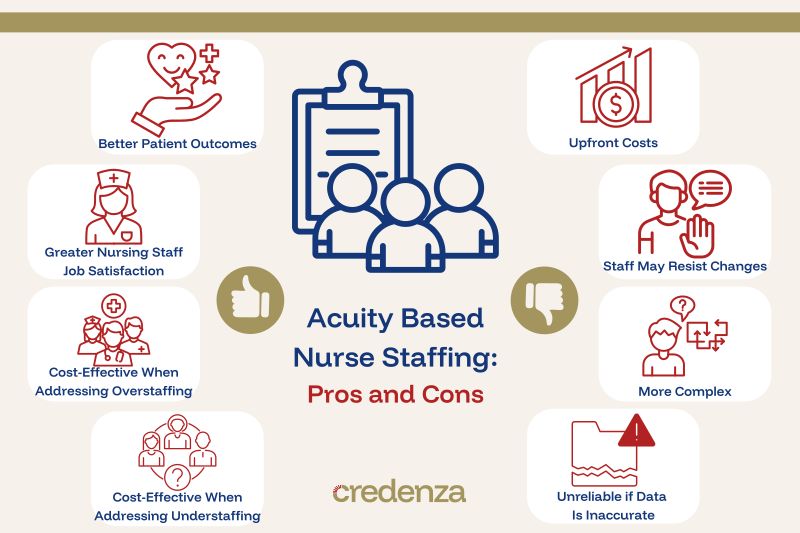
ABS model pros include:
- Better patient outcomes due to fewer adverse events and reduced incidents of missed care.
- Greater nursing staff job satisfaction and reduced turnover and burnout rates.
- Reduced labor costs by minimizing unnecessary overstaffing, preventing excess staffing expenses and avoidable shift cancellations.
- Enhanced risk mitigation because adverse events are often linked to understaffing and unsafe clinical workloads.
ABS model cons include:
- Greater upfront costs due to the investment in acuity measurement technology and integration of technology with existing systems, for example.
- Difficult staff buy-in in the face of existing assignment structures and the potential for higher caseloads when the acuity of care doesn’t warrant standard assignment sizes.
- Higher leadership demands because the model requires more managerial maintenance and input than volume-based staffing models.
- Potential ineffectiveness if patient data and nurse documentation of assessments are not accurate and high-quality.
Healthcare Settings That Can Benefit From Acuity-Based Nurse Staffing Models
Because ABS is designed to help facilities account for varying levels of patient needs, it works best in settings that do, in fact, care for patients with a variety of needs. Acute care facilities treating patients with complex medical conditions see this type of diversity. For example, a general med-surg unit may have patients with a variety of illnesses and conditions, some more severe than others, that require a range of nursing interventions.
Healthcare Settings Where Acuity-Based Nurse Staffing Models May Be Inefficient
Some settings and facility types don't require a staffing model as adaptive and responsive as ABS. At these facilities, putting the systems in place to calculate the acuity of patients wouldn't be productive or financially responsible, and other staffing models may be a better fit. Settings where ABS would be inefficient include:
- Primary care offices that see patients by appointment.
- Ambulatory surgery centers that focus on a narrow range of planned, same-day procedures.
- Long-term care facilities with relatively stable residents.
Want More Healthcare Leadership Insights?
Exploring acuity-based staffing for your facility is just one way you can support your nursing staff and patients. Looking for more insights? Our healthcare industry tips and resources are written by experts to help you reach your leadership goals.