

Nurses Week history tells the story of how a simple idea — recognizing nurses — grew into a nationwide celebration. It traces back to 1953, when Dorothy Sutherland proposed establishing a national day to honor nurses. Though it wasn’t immediately adopted, the idea stuck, grew, and eventually became official in 1974. At present, every May 6–12, we celebrate nurses and the heart they bring to caring for others.
Want to know how National Nurses Week started, why it’s celebrated in May, and how it’s changed over the years? Let’s dive into the history of Nurses Week and what it represents today.
Nurses Week History: What Is It Today?
Celebrated annually from May 6 to 12, Nurses Week is a nationally recognized celebration dedicated to honoring nurses — America’s most trusted profession. They’re the ones caring for critically ill patients in the emergency rooms (ERs), holding the hands of elderly patients in nursing homes, and welcoming new life in labor and delivery rooms. They educate, conduct research, lead care teams, and advocate fiercely for the people they serve.
This annual observance begins on May 6, known as National Nurses Day. It ends on May 12, which is International Nurses Day and the birthday of Florence Nightingale, the founder of modern nursing.
Throughout National Nurses Week, hospitals, schools, and communities come together to celebrate nurses through heartfelt stories, meaningful gifts, and simple acts of kindness that remind nurses their work truly matters — every shift, every patient, every day.
When Is Nurses Week 2026 Celebrated?
National Nurses Week 2026 is a key part of National Nurses Month, celebrated each May. From May 6 to 12, it’s the most recognized week of the month, observed across healthcare facilities and communities across the country. Several days within the week also carry special meaning:
- National Nurses Day — May 6
- National School Nurse Day — May 6 (celebrated on the Wednesday of National Nurses Week)
- National Student Nurses Day — May 8
- International Nurses Day — May 12
Nurse Appreciation Week 2026 is filled with events across the country. Check your state board of nursing or local community listings to see what’s going on near you. Here’s a look at what you might find:
- Webinars and lectures that dive into nursing history and other relevant topics
- Concerts and shows that celebrate the nursing profession
- Landmarks and buildings illuminated in honor of nurses nationwide
- Fun challenges and giveaways that promote wellness and include prizes just for nurses
- Award ceremonies that recognize outstanding nurses for various accomplishments
- Community events that offer free meals and gifts for nurses
- Virtual celebrations with online thank-you messages and tribute videos to engage nurses nationwide
- Nurses Week freebies and discounts from local and national businesses
Nurses Week: History of the Profession
Nursing is the largest healthcare profession in the U.S., with close to 4.7 million registered nurses (RNs) serving communities nationwide. Worldwide, the nursing workforce exceeds 29 million.
But how did the nursing profession start? While nursing as a form of care has existed for centuries, it only became a formal profession in the 19th century. Before that, caregiving was largely done informally by family, religious groups, or volunteers during wars or epidemics — and since it wasn’t seen as a formal field, there were no holidays to honor it.
The turning point came during the Crimean War (1853–1856), when Florence Nightingale, a British social reformer and statistician, dramatically transformed the perception of nursing. Sent to care for wounded soldiers, she introduced organized care practices, such as sanitation and infection control, which reduced mortality rates and proved that nursing could be a skilled, evidence-based profession.
Nurses Week History: How the Celebration Began
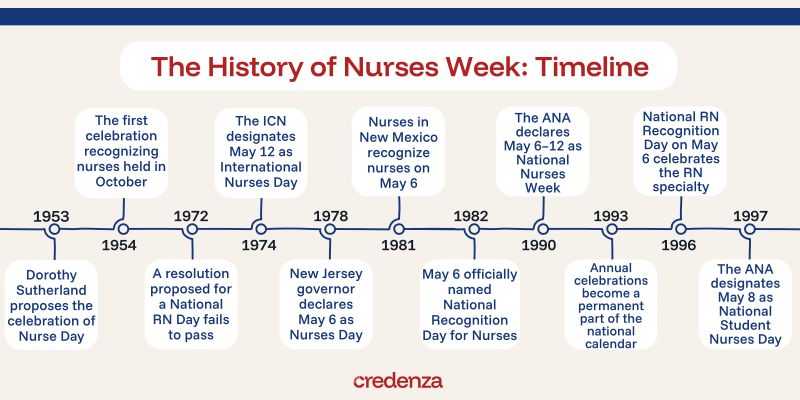
The history of National Nurses Week reflects a long journey toward formal recognition of nurses in the U.S. Much like the story behind the National Vietnam Nurses Memorial Sculpture, it wasn’t a straight path — it took time, effort, and plenty of challenges along the way. Here’s a quick look at how Nurse Appreciation Week eventually became a reality:
1953
The first notable effort to establish a national day for nurses came in 1953, when Dorothy Sutherland of the U.S. Department of Health, Education, and Welfare proposed a Nurse Day to President Dwight D. Eisenhower. While the proclamation was not issued at that time, it sparked interest in formally recognizing nurses for their contributions to public health.
1954
The first celebration dedicated to recognizing nurses took place from October 11–16, 1954, marking the 100th anniversary of Florence Nightingale’s mission to Crimea. Another bill was introduced the following year to make it official, but Congress took no action.
1972
The House of Representatives once again introduced a resolution asking the President to declare a National Registered Nurse Day, but it didn't pass.
1974
In 1974, the International Council of Nurses (ICN) officially designated May 12 — Florence Nightingale’s birthday — as International Nurses Day. That same year, President Richard Nixon proclaimed a National Nurses Week in the U.S., further legitimizing the observance. However, the celebration initially took place in February.
1978
New Jersey Governor Brendan Byrne declared May 6 as Nurses Day. Edward Scanlan of Red Bank, NJ, helped keep the tradition going by getting the date listed in Chase's Calendar of Annual Events and promoting it independently.
1981
Nurses in New Mexico, with support from Congressman Manuel Lujan, introduced a resolution to recognize May 6, 1982, as National Recognition Day for Nurses. The American Nurses Association (ANA) and several other nursing organizations rallied behind the effort.
1982
In 1982, the ANA, a long-standing advocate for nurses and their recognition, supported a joint resolution in Congress to declare May 6 as National Recognition Day for Nurses. Later that year, President Ronald Reagan signed the proclamation into law, officially marking May 6 as a day to honor nurses across the country.
1990
Recognizing that a single day was not enough, the ANA expanded the celebration in 1990, declaring May 6–12 as National Nurses Week. This decision gave space for a more comprehensive celebration, offering seven full days to recognize nurses in every role, specialty, and stage of their careers.
1993
By 1993, the appreciation week for nurses had become a permanent fixture on the national calendar, with the ANA formally designating it as an annual celebration to be held each year. Since then, it has continued to evolve into a large-scale celebration that includes various events and activities designed to honor nurses for their contributions to healthcare.
1996
The ANA introduced the idea of National RN Recognition Day to recognize the hard work of registered nurses. The ANA encouraged state and territorial nursing associations, along with other groups, to recognize the day as well.
1997
The ANA Board of Directors named May 8 National Student Nurses Day, following a request from the National Student Nurses Association.
Nurses Week History: What Nurses Want Today
As we approach this year’s celebration, it’s important to remember that this celebration is not just about honoring famous nurses like Edith Cavell and Clara Barton. It’s also about every nurse working tirelessly right now — in hospitals, military facilities, public health clinics, schools, and rural clinics — because without their daily work, there would be no safety net when people need care the most.
Despite the love and trust nurses have earned from the public, many nurses don’t always feel that appreciation in their day-to-day lives. Recent research shows the real struggle behind the care they give: burnout is climbing, job satisfaction is dropping, and more nurses are being pushed to the edge — some even leaving the profession altogether. On top of that, many feel unsupported in their own workplaces — almost half of hospital nurses believe their concerns aren’t being heard.
To truly support nurses, we have to shift the focus from praising what they do and start recognizing who they are — people with real limits, needs, and lives outside of work. Instead of glorifying constant self-sacrifice, we need to make it clear that their health and well-being matter just as much as the care they give. No one should have to burn out or suffer in silence just to keep the system going.
Real change is the key — a better work environment, fairer pay, and manageable patient-to-nurse ratios would not only show nurses appreciation but also help them enjoy their work from day to day. Nurses deserve to be cared for, too.
Frequently Asked Questions: Nurses Week History
Is Nurses Week just for registered nurses?
Not at all. It’s a celebration of all nurses — including licensed practical nurses (LPNs), nurse practitioners (NPs), nursing students, school nurses, and more.
What is the theme for Nurses Week this year?
Every year, the ANA announces a yearly theme that reflects current challenges or shines a light on vital areas of nursing. In 2026, the American Nurses Enterprise is celebrating “The Power of Nurses,” honoring not only the incredible impact nurses make every day, but also the tough realities they face while caring for others.
Who organizes events for Nurse Appreciation Week?
Events aren’t run by just one single group — they’re organized by a mix of organizations at different levels. At the national level, professional nursing organizations (like the ANA) help promote the week and provide themes, resources, and ideas for recognition. From there, hospitals, healthcare systems, and clinics take the lead in planning local celebrations for their own nursing teams.
You’ll also see support from state boards of nursing, nursing schools, and even local businesses, like supermarkets and coffee shops, all joining in to host special events, offer discounts, or show appreciation in other meaningful ways.
How is Nurses Week celebrated?
Each organization chooses its own way to celebrate it. From decorating break rooms and hosting catered lunches to massage therapy pop-ups, employers look for meaningful ways to say thank you to their nursing staff. Some organizations may even host giveaways and award ceremonies to honor outstanding team members.
Celebrate You — Explore Nursing Jobs You’ll Love
Nurses Week history reminds us how powerful this profession is. At Credenza, we take it a step further by helping nurses find meaningful job opportunities that align with their values, goals, and lifestyle preferences. Because your well-being matters just as much as the care you give.