SIU Medicine

Nurse Administrator (0066)

$6,099.24 - $6,709.16 / month
The Nurse Administrator is responsible for supervising the Department of Otolaryngology Charge nurse staff, Medical insurance specialist staff, and for the daily operations of the clinical services for the Department of Otolaryngology. Administrative Duties 60%
A. Serves with assisting Charge nurse with administrative and production supervision for the Department of Otolaryngology.
B. Maintains overall responsibility for the hiring, training, discipline and evaluating of staff within the Nursing unit. Assigned responsibilities and duties may be delegated to subordinate staff.
C. Coordinates and chairs staff meetings on a regular basis with nursing staff and MA staff in separate meetings.
D. Assigns nursing and clinic support staff appropriately to maximize optimum efficiency in clinics.
E. Coordinates and assigns clinic examination rooms.
F. Evaluates clinic functions on a regular basis and PRN utilizing patient satisfaction reports.
G. Provides direction to nursing staff individually or as a group.
H. Develops, revises, and implements nursing and clinic procedures and policies.
I. Meets as needed with Department Administrator and core staff, ensuring efficient operation of clinics.
J. Acts as a liaison between faculty, healthcare administrators and nursing staff.
K. Ensures a professional environment is maintained by nursing staff.
L. Ensures that all areas of clinic and equipment used are clean, organized, and safe I y stored according to policy and procedure.
M. Works with Charge Nurse in developing and revising patient education brochures to meet needs, regulations, and updating information PRN and annually.
N. Advises Medical office Coordinator on appropriateness of patient appointments and clinic schedule efficiency.
0. Assumes additional responsibilities as assigned by the assistant to the chair for Department of Otolaryngology
P. Works with Healthcare in regards to communication and educating the Department of Otolaryngology on new policies/ procedures, regulation updates, and accreditations.
Q. Organizes clinic patient flow and revises as necessary to maximize physician productivity and minimize patient wait times.

Education 25%
A. Provides and participates in staff and community education programs.
B. Provides orientation to daily clinic activities and training for nursing personnel, students and residents.
C. Assists with instruction of Office Support in the provision of patient activities.
D. Functions as resource person for general public requesting information in regards to the Department of Otolaryngology.
E. Works with Charge nurse in completion of annual training and competencies.

Nursing Duties 10%
A. Provides clinic nursing care and delegation of clinical duties to LPN's and Ma's while in clinic. This care may include, but not be limited to, obtaining patient histories, assisting with portions of physical examinations, administering medications, providing wound care, performing other nursing procedure and documenting nursing functions
appropriately.
B. Performs clinic laboratory testing and procedural testing according to clinic protocols. Reports findings to physician and records on patient medical record.
C. Assists with procedures. Sets up and/or completes procedures as necessary under the direction of the MD, AP, or PA.
D. Develops and implements patient plan of care with the MD, APN, and / or PA.
E. Coordinates delivery of patient plan of care.
F. Organizes clinic patient flow and revises as necessary to maximize physician productivity and minimize patient wait times.
G. Schedules follow-up patient activities including radiology studies, surgical procedures and other testing as ordered by the MD, APN, or PA.
H. Prepares for upcoming clinics by obtaining history from referring physician, pertinent radiologic studies, laboratory results, and operative reports when appropriate.
I. Communicates with call center, patients, families and other healthcare professionals.
J. Uses critical thinking skills to triage patient care priorities for patient phone calls and needs.
K. Utilizes and maintains equipment used in the assessment and treatment of patients.
L. Ensures accurate, current, and safe nursing procedures pertaining to patient care through appropriate supervision of clinical personnel in the clinical area.
M. Acts as liaison between healthcare facilities and other specialty agencies.
N. Functions as a primary nurse or back-up nurse as directed depending on the need. Follows direction of the primary nurse and physician when functioning as the back-up nurse.
O. Serves as a resource to Departmental staff.

Research Duties 5%
A. Assists with planning and implementation of research projects as related to patient care.
B. Follows research protocol when conducting patient research, including obtaining informed consent, providing patient care as directed by research methodology, and documenting patients are according to protocol or clinic standards.
C. Collects and analyzes data and assists when publishing results as needed.
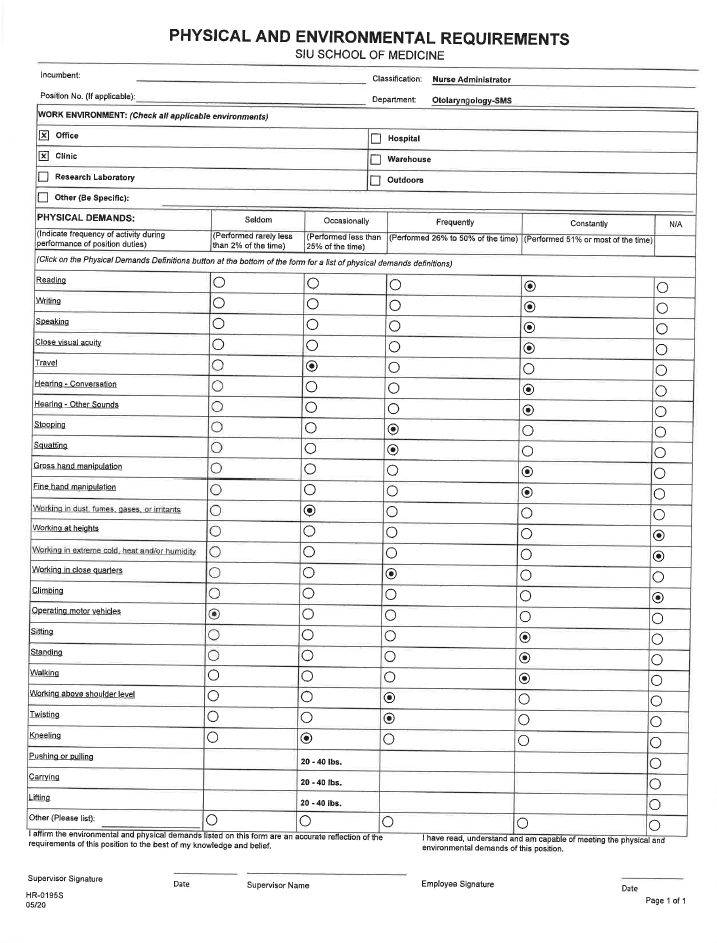


Credentials to be Verified by Placement Officer

  1. Licensure as a Registered Professional Nurse in Illinois.

    1. Bachelor degree in nursing or health related field and 2 years supervisory/administrative experience in a health care field
      OR
    2. Four years of supervisory/administrative experience in a health care field.
  2. Two years of work experience as a Registered Professional Nurse.

Knowledge, Skills & Abilities (KSA’s)

  1. Excellent written and verbal communication skills.
  2. Ability to work with others as a member of multiple disciplinary team.
  3. Strong problem solving abilities.
  4. Adaptability
  5. Strong working knowledge of and ability to provide excellent customer service.
  6. Ability to use independent judgment and initiative.

Condition of Employment

Out of State Applicants that apply to Springfield vacancies in classifications in the occupational area of Professional, Semi-Professional, or Managerial will be subject to the following Condition of Employment: Pursuant to the State University Civil Service System, an out-of-state resident who is hired into this position must establish Illinois residency within 180 calendar days of their start date. 


Share this job

Share to FB Share to LinkedIn Share to Twitter

Related Jobs

Arcadia Care Auburn

Registered Nurse RN

$40 - $45 / hour
Registered Nurse (RN) Job Summary: The Registered Nurse (RN) is responsible for providing high-quality care in a collaborative, team-based environment. Salary ranges $40-$45/hour. We foster growth, training and development and a supportive leadership culture. Essential Duties: Residents assessments Care Plan development by collaborating with other healthcare professionals Coordination with IDT to optimize health outcomes Supervision of CNAs Compliance with IDPH/CMS Benefits Offered: Extremely low-cost Health, Dental, Vision, 401K, and more $25,000 Company Paid Life Insurance – at no cost to you Leadership Training to enhance your management skills Daily Pay - get your money when you want Paid Vacations - rolls over each year Paid Sick Time Paid Holidays Tuition Reimbursement Daily, Weekly, Monthly Employee Appreciation Events Birthday, Anniversary Celebrations Full-time, Part-time, PRN available Free Employee Assistance Programs - professional support & guidance on family, money, health, legal services and more Huge Discounts at all major retailers (Walmart, Costco, etc.) at no cost to you Virtual Visits with Doctors 24/7, without setting up additional accounts or appointments Paid Break Time for Nursing Mothers Time Off to Vote Qualifications: Active Illinois Registered Nurse license Long Term Care (LTC) experience preferred Strong, effective communication Exemplary leadership skills We have one Full-Time night shift open (6 pm - 6 am) and one PRN position open
Detroit Medical Center

Chief Nursing Officer DMC Huron Valley-Sinai Hospital

Job Summary COMPANY BACKGROUND Tenet Healthcare Corporation (NYSE: THC) is a diversified healthcare services company headquartered in Dallas. Our care delivery network includes United Surgical Partners International, the largest ambulatory platform in the country, which operates ambulatory surgery centers and surgical hospitals. We also operate a national portfolio of acute care and specialty hospitals, other outpatient facilities, a network of leading employed physicians and a global business center in Manila, Philippines. Our Conifer Health Solutions subsidiary provides revenue cycle management and value-based care services to hospitals, health systems, physician practices, employers, and other clients. Across the Tenet enterprise, we are united by our mission to deliver quality, compassionate care in the communities we serve.. For more information, please visit www.tenethealth.com . MARKET SUMMARY: Detroit Group DMC Huron Valley-Sinai Hospital, Commerce Township, Michigan Located in Commerce, Michigan, a suburb 25 miles northwest of Detroit, DMC Huron Valley-Sinai Hospital is one of eight hospitals/institutes composing the Detroit Medical Center . Huron Valley-Sinai Hospital is a full-service community teaching hospital with 158 licensed beds, including 6 pediatric beds in a partnership with Children’s Hospital of Michigan. The hospital is staffed by more than 420 physicians (288 active including 40 employed), 330 nurses, and 800 support staff ser v icing more t han 40,000 patients a nn ually . T he hospital annually has more than 9,500 admissions, and performs more than 2,500 inpatient and 5,000 outpatient surgeries. Huron Valley-Sinai Hospital features the Harris Birthing Center, a regional specialty center, the Charach Cancer Treatment Center, surgical suites, cardiac services, and comprehensive inpatient and outpatient diagnostic care. The hospital is located in Oakland County, among the ten highest income counties in the United States with a population over one million people. Oakland County is comprised of 61 cities, townships and villages. The communities served by Huron Valley-Sinai Hospital are mostly suburban and rural, and the area features dozens of lakes, and state and county parks, and is a recreational destination for hundreds of thousands in Southeast Michigan. T h e Hospita l 's busy emergency dep ar tment t r eats more than 33,000 patients each yea r . Cardiology services incl u de all surgical procedures except transplant, with f o ur cardiac cath labs available. Orthopaedics and oncology are also core service l ines, with on-site r adiation oncology services a nd a chemotherapy/ i nfusio n clin i c. Ob s tet r ics ca r e i ncludes high-r isk pr e gnancy management, maternal / feta l m e dicine , and complete labo r and del i very s e r v ic e s. Cr i t i cal care un i ts treat cardiac, surgical, trauma, and medical cases. In addit i o n to i t s m a i n hospital facilities , Huron Valley-Sinai Hospital operates two ou t pa ti en t clinics, inc l uding the Charach Cancer Center and an imaging center in Novi, a suburb 10 miles southeast of the hospital. Huron Valley-Sinai Hospital was founded in 1986, and grew quickly thanks to the generosity of William Carls and the Carls Foundation. To honor this philanthropic history, Huron Valley-Sinai Hospital is located on 1 William Carls Drive. Huron Valley-Sinai Hospital is fully accredited by the Joint Commission on Accreditation of Healthcare Organizations (JCAHO). The Joint Commission assesses the quality of care and safety for more than 15,000 health care organizations. The Joint Commission conducts an extensive on-site review at least once every three years whose purpose is to evaluate the organization's performance in areas that affect patient care. http://www.hvsh.org/ POSITION SUMMARY The Chief Nursing Officer provides strategic leadership as the senior executive position responsible for all nursing and other designated patient care functions and services within the hospital organization. The role assumes responsibility for assessing, planning, coordinating, implementing, and evaluating nursing practice on a facility level. The role assumes 24/7 responsibility and has accountability to ensure high quality, safe and appropriate nursing care, competency of clinical staff, and appropriate resource management related to patient care. The Chief Nursing Officer represents nursing concerns on the governing board and at medical staff leadership meetings. Responsibilities FUNCTIONAL EXPECTATIONS & REQUIREMENTS: Retaining great people at the facility Collaborate with human resources and other team members to select, on-board, orient, and provide coaching for direct reports. Evaluate and monitor facility level people pillar statistics, participate on related calls, as necessary. Consider and/or implement nurse residency programs to ensure pipeline for facility. Collaborate with team members to formulate programs to enhance work life balance. Partner with related team members to promote a safe work environment that is based on a zero tolerance for sexual harassment, workplace violence and verbal and physical abuse. Collaborate with related team members to promote an effective facility level competency program. Collaborate to promote a robust employee development and education program that responds to the unique needs of employees across the career continuum (novice to expert). Work cohesively with related team members to develop and implement recruitment and retention strategies that ensure a qualified and stable workforce. Participate in workforce planning to ensure an adequate and competent workforce. Support the design of effective and competitive compensation and benefits programs. Communication and Relationship Building Effectively communicate with all internal and external constituents, including staff, colleagues, and physicians. Communicate and administer human resource programs and procedures in accordance with established policies. Manage organizational relationships in a manner which builds mutual trust and respect. Establish trusting and collaborative relationships. Address and manage conflict in a constructive and productive manner. Give timely feedback and reinforce positive behaviors. Leadership Influence Create and communicate a compelling shared vision. Develop effective strategies for addressing organizational priorities. Develop, communicate, and monitor performance expectations. Formulate objectives, goals, and specific strategies related to the organization’s mission and vision. Understand effective organizational outcome measures in order to balance cost, quality, and service. Measure and analyze performance from the learning and growth, business process, customer, and financial perspectives. Promote a results-oriented environment. Develop succession plan for nursing leadership. Demonstrate effective change management; able to serve as an organizational change agent. Coach and mentor aspiring nurse leaders. Create an environment in which professional and personal growth is an expectation. Articulate the application of ethical principles to operations. Manage organizational and individual performance with appropriate rewards. Represent nursing and patient care issues within the organization’s governance and medical staff structures. Represent nursing and patient care in strategic planning and quality initiatives with the governing body. Educate the organization’s board members and physicians regarding healthcare/value of nursing care. Diversity Create an environment that recognizes and values diversity. Develop processes to incorporate cultural beliefs into care. Design strategies that address the unique needs of a diverse workforce, patient population, and community. Assess the current environment and establish indicators of progress toward cultural competency. Shared decision-making/Shared Leadership Engage staff and others in decision-making. Promote decisions that are patient centered. Provide an environment conducive to opinion-sharing. Promote systems thinking as a value in the nursing organization. Consider the impact of nursing decisions on the health care organization as a whole. Provide leadership in building loyalty and commitment throughout the organization. Synthesize and integrate divergent viewpoints for the good of the organization. Involves employees in decision-making. Attend and participate in regional CNO calls and meetings. Clinical Practice Leadership Understand and articulate patient care standards reflected in federal and state regulation, TJC, the state Nurse Practice Act, and organizational policies and procedures. Maintain knowledge of current nursing practice and roles and functions within nursing and other healthcare disciplines. Maintain current knowledge of patient care delivery systems and innovations. Ensure that nursing practice is consistent with current standards and current evidenced based practice. Ensure that the care delivery model, clinical environment of care and related technology is appropriate to needs of caregivers and patients. Serve as change agent when patient care work/workflow is redesigned. Advocate use of documented best practices. Teach and mentor others to routinely utilize evidenced based data and research. Assure that the clinical perspective is included in organizational decisions. Supports regional senior director and Tenet CNO. Academic Relationships Provide a supportive and stimulating learning environment for nursing students. Participate in the academic community through advisory and collaborative efforts. Ensure that the educational system is aligned with organizational needs. Collaborate with nursing programs to provide required resources; evaluate graduates. Collaborate with academia in nursing research and incorporate nursing research into practice. Resource Management Demonstrate a comprehensive understanding of organizational revenue, expense performance and capital planning. Manage fiscal, human, and material resources in a cost-effective manner. Design and maintain effective systems for resource management in nursing. Manage patient care processes such as care management/length of stay to ensure optimal revenue. Utilize effective performance management in managing key areas of responsibility. Quality, Patient Safety and Risk Management Contribute to the development and implementation of the organization’s performance improvement program. Support the development and implementation of an organization-wide patient safety program. Monitor and evaluate quality through public reported measure (i.e., core measures, nurse sensitive patient outcomes, infection control, etc) in collaboration with the facility DCQI and ICP, as well as national resources. Actively participate in facility clinical close calls. Define quality metrics by identifying the problem/process, measuring success at improving specific areas of patient care, analyzing the root causes or variation from quality standards, improving the process with the evidence, controlling solutions and sustaining success. Interpret information from research. Participate in studies that provide outcome measurements. Utilize research findings for the establishment of standards, practices, and patient care models in the organization. Disseminate research findings to patient care team members. Support the development of a facility-wide patient safety program. Support a non-punitive environment and a reward system for reporting unsafe practices. Design safe clinical systems, processes, policies, and procedures. Allocate nursing resources based on measurement of patient acuity/care needed. Ensure staff is clinically competent and trained on their role in patient safety, performance improvement, and risk management. Support a safe culture that assures accountability and respects values and individual contributions. Incorporate safety as a design element as appropriate. Collaborate with RM to monitor and follow up on clinical risk trends. Identify, mitigate, and take action to correct areas of risk/liability in patient care. Facilitate facility level annual pressure ulcer prevalence and incidence study results with corrective action. Collaborate with related team members to monitor and evaluate a Culture of Safety through active coaching of direct reports to ensure that the culture of safety is cultivated at the facility. Support the annual AHRQ Patient Safety Survey and follows up with corrective actions. Information management and technology Supports and embraces role in the adoption of EMR within facility. Demonstrates basic competency in technology applications related to business and clinical functions. Recognizes the relevance of nursing data for improving practice. Utilizes facility database management, decision support, and expert system programs to access information and analyze data from disparate sources for use in planning for patient care processes and systems. Participates in system change processes and utility analysis. Evaluates and revises patient care processes and systems. Participates in the evaluation of information systems in practice settings. Uses computerized management systems to record administrative data (billing data, quality assurance data, workload data, etc.). Uses applications for structured data entry (classification systems, acuity level, etc.). Recognizes the utility of nursing involvement in the planning, design, choice, and implementation of information systems in the practice environment. Demonstrates awareness of societal and technological trends, issues, and new developments as they apply to nursing. Demonstrates proficient awareness of legal and ethical issues related to client data, information, and confidentiality. Reads and interprets benchmarking, financial and occupancy data. Service Monitor and evaluate service indicators in collaboration with related team members at the facility level. Facilitate education of employees related to service. Actively facilitate Physician satisfaction survey, monitors result and collaborates with facility team members to develop and implement action plans. Monitor and evaluate results of annual Employee Satisfaction Survey and collaborate with related team members to develop and implement action plans. Professional Role Model Advocate for nursing. Assume personal and professional accountability. Follow through on commitments. Integrate high ethical standards and core values into everyday work activities. Maintain a professional network of colleagues. Contribute to the profession of nursing through professional organizations, publication, and other professional endeavors. Participate in the legislative process and health policy issues that impact nursing and health care delivery. ORGANIZATIONAL LEADERSHIP - EXPECTATIONS & REQUIREMENTS: As a leader in healthcare, Tenet is committed to providing the best possible care to every patient, with a clear focus on quality and service. Strong leadership is essential to delivering on this commitment, and we believe that the quality of our leaders can give us a significant long-term competitive advantage. We want to ensure every current and future leader in Tenet is successful, and we support that through our selection and hiring process and by providing coaching and training to our leaders. In this regard, we have identified core competencies that will enable a leader to succeed at Tenet, and have defined them within the following five areas critical to performance: Use Astute Judgment Promotes decisions that are patient-centered (e.g., plans to reduce noise in patient areas at night). Promotes “systems thinking” as a value in the nursing organization. Synthesizes and integrates divergent viewpoints for the good of the organization (e.g., implements shared governance councils). Considers impact of nursing decisions on the healthcare organization as a whole (e.g., reduces falls, pressure ulcers, and other nurse sensitive patient outcomes). Provides leadership in building loyalty and commitment throughout the organization (e.g., builds career development path for high performing staff). Assures that the clinical perspective is included in organizational decisions (e.g., leads work that results in successful JC accreditation). Shape Strategy Formulates objectives, goals, and specific strategies related to the organization’s mission and vision (e.g., participates in preparing the budget with cost improvements in nursing departments). Promotes a results-oriented environment (e.g., cascades and measures BSC, CQ BSC, and CNO BSC targets). Represents nursing/patient care issues within the organization’s governance and medical staff structures (e.g., actively participates in governing board by presenting a monthly nursing report). Represents nursing/patient care in strategic planning and quality initiatives with the governing body (e.g., presents new ideas and external and internal benchmarks at board meetings). Monitors and evaluates quality through public reported measure (e.g., core measures, nurse sensitive patient outcomes, infection control, VBP risk protection, etc.) in collaboration with the facility DCQI and ICP, as well as national resources. Supports the development of a facility wide patient safety program (e.g. zero never events; reduced falls with injury, reduced facility acquired pressure ulcers, etc.; meets targets on CNO BSC). Designs safe clinical systems, processes, policies, and procedures. Apply Financial Insights Allocates nursing resources based on measurement of patient acuity/care needed (e.g., meets JC conditions of participation for nursing services). Demonstrates sense of urgency in management of labor expense (e.g., meets targets for SWB). Ensure Collaboration Effectively communicates with all internal and external constituents, including staff, colleagues, and physicians (e.g., holds weekly staff meetings with Department Directors, routinely rounds with physicians). Builds “privileged relationships” with key internal stakeholders (e.g., CEO, RSVP, etc.) and manages organizational relationships in a manner which builds mutual trust and respect. Addresses and manages conflict in a constructive and productive manner (e.g., immediately addresses a conflict situation between a nurse and physician to a positive outcome). Actively networks and creates peer relationships with other internal and external nursing leaders (e.g., leadership role in industry organizations, actively mentors, etc.). Drive Organizational Success Understands and articulates patient care standards reflected in federal and state regulation, TJC, the state Nurse Practice Act, and organizational policies and procedures. Ensures that the care delivery model, clinical environment of care and related technology is appropriate to needs of caregivers and patients. Supports and embraces role in the adoption of EMR within facility and successfully implements within SWB budget. Recognizes the utility of nursing involvement in the planning, design, choice, and implementation of information systems in the practice environment. Monitors and evaluates service indicators (Press Ganey Patient Satisfaction Reports) and implements action plans in collaboration with related team members at the facility level (e.g., action to implement formal discharge calls). Actively facilitates Physician satisfaction survey, monitors result, and collaborates with facility team members to develop and implement action plans (e.g., action to improve communication with physicians). Monitors and evaluates results of annual Employee Satisfaction Survey and collaborates with related team members to develop and implement action plans (e.g., action to increase recognition). Develop Organizational Talent Participates in workforce planning to ensure an adequate and competent workforce. Recruitment and retention strategies, employee development/education program (e.g., meets targets for People pillar for nursing including turnover,
City of Hope

Chief Nursing Officer

Chief Nursing Officer About City of Hope , City of Hope's mission is to make hope a reality for all touched by cancer and diabetes. Founded in 1913, City of Hope has grown into one of the largest and most advanced cancer research and treatment organizations in the U.S., and one of the leading research centers for diabetes and other life-threatening illnesses. City of Hope research has been the basis for numerous breakthrough cancer medicines, as well as human synthetic insulin and monoclonal antibodies. With an independent, National Cancer Institute-designated comprehensive cancer center that is ranked top 5 in the nation for cancer care by U.S. News & World Report at its core, City of Hope’s uniquely integrated model spans cancer care, research and development, academics and training, and a broad philanthropy program that powers its work. City of Hope’s growing national system includes its Los Angeles campus, a network of clinical care locations across Southern California, a new cancer center in Orange County, California, and cancer treatment centers and outpatient facilities in the Atlanta, Chicago and Phoenix areas. The successful candidate: We’re looking for our next Chief Nursing Officer. This is more than a nursing leadership opportunity. We’re seeking a Chief Nursing Officer who is energized by transformation, growth, and building for the future. Our ideal leader brings: Significant inpatient and outpatient hospital experience with a focus in cancer Executive nursing leadership experience A track record of transformation and growth A passion for developing high-performing clinical teams A strong commitment to quality, patient experience, and operational excellence This is your opportunity to transform a location, grow its capabilities, and shape what comes next. Strategic Leadership Serve as a member of the hospital Executive Leadership Team and advance organizational goals and objectives. Represent the voice of nursing in organizational planning and decision-making across the continuum. Align patient care services goals with the strategic direction of City of Hope Atlanta. Set the strategy and vision for clinical services, future growth, high reliability, nursing resources, staffing models, and daily resource allocation. Business Outcomes Lead nursing operations, clinical nursing practice, clinical policy, and patient engagement across the care continuum. Participate in resource allocation and mentor nursing leaders in financial and operational leadership. Establish workforce-productivity and staffing standards and partner with Talent on workforce planning, succession, recruitment, retention, and market analysis. Hold leaders accountable for policy, regulatory, quality, and operational requirements and partner with Supply Chain on product standardization Leadership in the Health Care Environment Guide the development, implementation, monitoring, and sustainability of clinical best practices. Partner with the Chief Medical Officer and enterprise clinical leadership to improve clinical operations and outcomes. Advance evidence-based standards, patient-care expectations, care-delivery models, accreditation, regulation, and patient safety. Seek opportunities to increase City of Hope’s presence and influence in healthcare. Communication and Relationship Building Represent the patient-care and nursing perspective to governing bodies and external audiences. Create and sustain a Magnet culture that attracts and retains clinicians. Build credibility and trust with enterprise leaders, boards, medical staff, clinical staff, and other stakeholders. Use shared-governance principles, develop academic partnerships, and strengthen interprofessional collaboration and long-term workforce planning. Requirements: Baccalaureate and Master's degree required; one of which must be in Nursing Current registered nurse license required. Licensed in the state of GA or the ability to obtain said license within 6 mos. Fifteen (15) years nursing experience, with ten (10) years in a nursing leadership role. Preferred Education: Doctorate in nursing or related field (i.e., PhD, DNP or comparable) Preferred Experience: Leadership experience within a Magnet organization City of Hope is an equal opportunity employer. City of Hope employees pay is based on the following criteria: work experience, qualifications, and work location. This position is eligible for an annual incentive bonus. Please note : City of Hope is committed to a safe and transparent hiring experience. Please be aware that scammers may attempt to impersonate our organization through fake job postings, emails or interviews. Apply only through our official website or trusted partner platforms. City of Hope will never request payment or fees at any stage of the hiring process. We will not request sensitive personal or financial information prior to the acceptance of a formal offer. All communications will come from official @coh.org email addresses. Interviews are conducted only through approved, professional channels. Be cautious of unsolicited communications, urgent requests or opportunities that seem inconsistent with standard hiring practices. If you receive any suspicious communication, please report it to careers@coh.org .
Rochester Regional Health

Associate, Chief Nursing Officer - Specialty Services - Ambulatory

$120,000 - $185,000 / year
Associate, Chief Nursing Officer - Specialty Services - Ambulatory Rochester, NY SUMMARY: The Associate Chief Nursing Officer (ACNO) reports to the Vice President and Chief Nursing Officer. The ACNO is the Senior Nursing Leader accountable for one or more service lines within the Patient Care Services Division. Has full responsibility for nursing operations, people management, strategic/clinical goals, and budget responsibility. RESPONSIBILITIES: Formulates the vision and strategic plan for their service line, in accordance with the Patient Care Services strategic plan Attract, retains, and develops the best and brightest Nursing Leadership Team Establishes and maintains an environment conducive to excellence in patient care Continually evaluates patient quality, safety, and performance, identifies improvement opportunities, and plans and implements improvement programs Establishes and maintains an environment that promotes a spirit of inquiry and is supportive of professional nursing practice and a evidenced based practices Promotes multi-disciplinary collaboration Engages in professional development activities Directs the development and implementation of standards, policies and programs to ensure excellence in nursing practice Assures compliance with applicable local, state, and federal regulations and accrediting agencies. Responsible for compliance in practice aligned with nursing excellence programs (Magnet, Beacon, Lantern, etc.) Prepares, administers, and monitors revenue, capital, expense, and personnel budgets for assigned departments in collaboration with department directors and finance team. Participates in establishing financial plans, integrating the institution’s mission and goals. Advocates for resources necessary for the optimal work environment and exceptional patient care Mentors and develops nursing staff at all levels to ensure appropriate succession plans are in place at all levels of the nursing organization and that a strong pipeline exists for future nursing leaders. REQUIRED QUALIFICATIONS: Bachelor’s degree in Nursing is required A Master’s degree in Nursing, Healthcare Administration, Business Administration, or a related field is also required. Current New York State Registered Nursing License. At least 5 years of progressive management experience with a clinical focus in a healthcare system. PREFERRED QUALIFICATIONS: Results driven leader with experience in developing, designing and executing clinical programs that create measurable outcomes in quality, service, finance, growth and people. EDUCATION: LICENSES / CERTIFICATIONS: PHYSICAL REQUIREMENTS: Sedentary - Sedentary roles are primarily office-based and require prolonged sitting (67–100% of the workday) with minimal physical effort and lifting limited to under 10 lbs. Fine motor skills are necessary for computer work, writing, and telephone use, supported by clear visual and auditory ability. Cognitive and emotional demands are high due to extended concentration, frequent interruptions, independent decision-making, and information processing. Although physical exposure is low, administrative areas within healthcare environments may occasionally involve contact with infectious agents. Some roles may require flexible hours, TB screening, or a valid driver’s license. For disease specific care programs refer to the program specific requirements of the department for further specifications on experience and educational expectations, including continuing education requirements. Any physical requirements reported by a prospective employee and/or employee’s physician or delegate will be considered for accommodations. PAY RANGE: $120,000.00 - $185,000.00 CITY: Rochester POSTAL CODE: 14617 The posted pay range is a good faith representation of potential base pay for this position. It may be modified in the future and eligible for additional pay components. Individual annual salaries/hourly rates could vary based on position details and FTE. Pay is determined by considering factors including, but not limited to, experience, relevant qualifications, specialty, internal equity, locations, and contracts. Rochester Regional Health is an Equal Opportunity Employer. All qualified applicants will receive consideration for employment without regard to race, color, creed, religion, sex (including pregnancy, childbirth, and related medical conditions), sexual orientation, gender identity or expression, national origin, age, disability, predisposing genetic characteristics, marital or familial status, military or veteran status, citizenship or immigration status, or any other characteristic protected by federal, state, or local law.
UF Health

VP, Chief Nursing Officer, Ambulatory

Overview UF Health is a leading academic health center serving Florida, the Southeast and beyond. Across our hospitals, colleges and research centers and institutes, experts collaborate to advance medicine through a shared mission and vision. UF Health is seeking an Ambulatory Chief Nursing Officer (CNO) UFHMG. This is an executive-level nurse leader responsible for overseeing nursing practice, clinical operations, and patient care standards across ambulatory clinic settings. The Ambulatory CNO UFHMG manages a decentralized network of practices and provides UF Health enterprise-level leadership for ambulatory clinic nursing services across physician practices and provider-based clinics. This role is accountable for advancing clinical quality, patient safety, professional nursing practice, and operational performance across a diverse and growing ambulatory clinic network. The Ambulatory CNO UFHMG reports directly to the UF Health System Chief Nursing Officer (CNO) and serves as the senior nursing leader for ambulatory clinic nursing services across the UF Health enterprise. The Ambulatory CNO UFHMG maintains a strong supportive relationship with the Physician Executives and the SVP UFHMG to drive operational performance, access, and care delivery optimization. In partnership with physician, nursing and operational leaders, the Ambulatory CNO UFHMG drives high-quality, patient centered, efficient, and compliant ambulatory care delivery while advancing nursing excellence, workforce engagement, care model innovation, and value-based outcomes across ambulatory clinic settings. Oversees performance of other key nursing leaders of ambulatory clinics such as AVP, nurse educators, nurse navigators, nurse managers. Responsibilities The role focuses on integrating clinical excellence with financial and operational performance across the care continuum. Strategic Leadership : Develops and executes nursing strategic plans for ambulatory clinic services, ensuring alignment with the overall health system’s mission and goals. Clinical Operations : Oversees daily operations in physician practices and outpatient clinics to ensure efficient, high-quality care delivery. Quality & Safety : Establishes and enforces evidence-based nursing standards, monitors quality metrics (e.g., patient satisfaction, infection prevention), and leads performance improvement initiatives. Financial Management : Manages ambulatory nursing operating budget, including resource allocation, staffing productivity, and cost-containment strategies. Regulatory Compliance : Ensures all ambulatory clinic sites comply with federal, state, and industry regulations, including the Joint Commission and CMS standards. Workforce Management : Leads recruitment, retention, and professional development programs for ambulatory clinic nursing staff, maintaining a focus on Magnet or Pathway to Excellence recognition. Technology Integration : Spearheads the adoption of new medical technologies, telehealth platforms, and electronic health record (EHR) workflows optimized for outpatient clinic care. Qualifications Education Bachelor of Science in Nursing (BSN) required. Master’s degree in nursing (MSN), Healthcare Administration (MHA), Business Administration (MBA), or Doctor of Nursing Practice (DNP) preferred. Experience 10+ years of progressive nursing leadership experience required. Experience in an ambulatory clinic or hospital outpatient setting preferred. Licensure/Certification/Registration Active, unrestricted Registered Nurse (RN) license required. Professional certification preferred, such as: Certificate in Ambulatory Nursing Nurse Executive Advanced (NEA-BC) Certified in Executive Nursing Practice (CENP)